
Neurofeedback studies
Current research and evidence
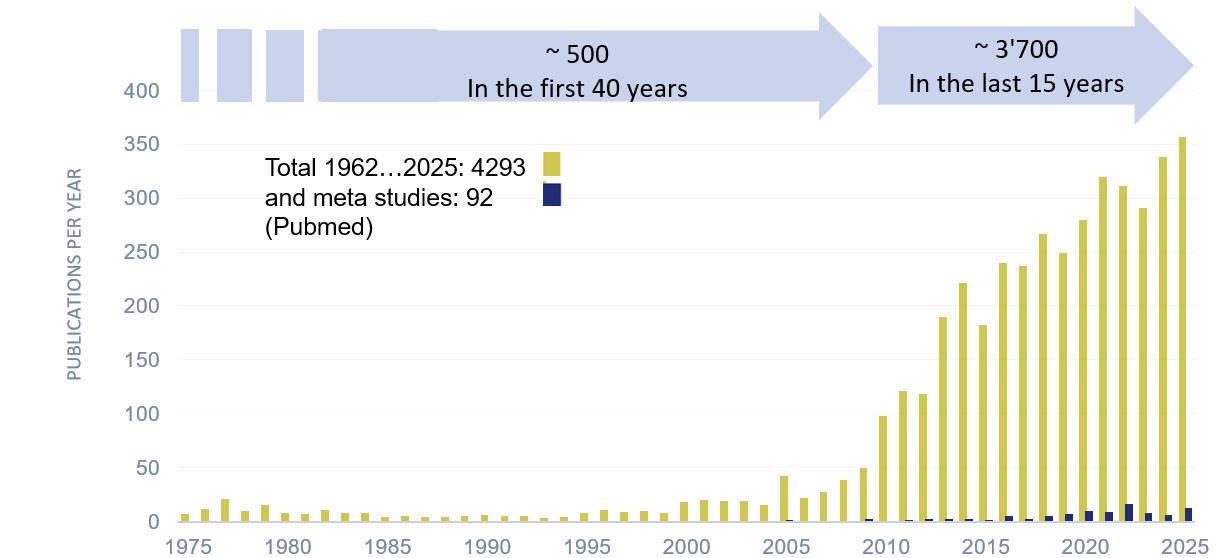
Trend in the annual number of scientific publications on neurofeedback in PubMed. Source: National Library of Medicine. PubMed, 10.11.2026
Since 1975, the number of neurofeedback publications recorded annually in PubMed has risen from 10 to 4293 (data as at: 10 November 2026). This trend highlights the scientific interest in neurofeedback.
In 2026, a study by the University of Zurich was published in the journal *NeuroImage*, providing new insights into the neurophysiological mechanisms of action of ILF neurofeedback.
In three randomised, double-blind and sham-controlled crossover studies, each involving 40 healthy participants, the research team investigated how different feedback components affect the brain’s functional connectivity.
The key finding: compared with the sham condition, the combination of classical frequency-band feedback and ILF feedback led to statistically significant changes in functional brain connectivity. When the feedback components were used individually, the primary analysis did not reveal any comparable significant effects.
These results are particularly relevant for BEE Medic, as the combination investigated corresponds to the feedback approach of ILF neurofeedback according to the Othmer method.
The study makes a significant contribution to our understanding of the neural processes that ILF neurofeedback can influence. Whether and how these changes affect clinical symptoms is the subject of further research.
Original publication:
de Matos, N. M. P., Stämpfli, P., Seifritz, E., & Brügger, M. (2026). Disassembling infra-low-frequency neurofeedback: A neurophysiological investigation of its feedback components. NeuroImage, 325, 121647.
In addition to the neurophysiological mechanisms of action, research is also investigating the clinical applications of ILF neurofeedback.
A study by Theis et al., published in 2025, analysed the treatment courses of 256 patients at an occupational therapy practice with various mental health and developmental diagnoses.
During the course of ILF neurofeedback training, there was a reduction in reported symptom burden as well as improvements in various attention parameters.
The results provide promising insights from therapeutic practice. However, as the study did not include a randomised control group, it is not possible to determine conclusively to what extent the observed improvements are attributable to ILF neurofeedback.
The neurofeedback study was conducted with the participation of staff from BEE Medic GmbH.
Original publication:
Theis, T., et al. (2025). ILF neurofeedback in clinical practice: examining symptom change and performance metrics across diagnostic groups. Frontiers in Human Neuroscience, 19, 1601187.
A key feature of ILF neurofeedback according to the Othmer method is the individual adaptation of the training. Electrode positions and training frequencies are determined by the trainee’s responses.
This individualisation enables a training programme tailored to the specific individual. At the same time, it poses particular challenges for scientific research, as individually adapted training protocols are more difficult to standardise and compare with one another.
A systematic review by Bazzana et al. (2022) examined 18 ILF neurofeedback studies. The authors described promising results and highlighted individualisation as a characteristic feature of the method. At the same time, they emphasised the importance of further controlled studies with clearly documented training protocols.
Original publication:
Bazzana, F., Finzi, S., Di Fini, G., & Veglia, F. (2022). Infra-Low Frequency Neurofeedback: A Systematic Mixed Studies Review. Frontiers in Human Neuroscience, 16, 920659.
Neurofeedback studies by area of application
ILF Neurofeedback Mechanisms and Neurophysiology
- de Matos, N.M.P., Stampfli, P., Seifritz, E. & Brügger, M. (2025): Disassembling Infra-Low-Frequency Neurofeedback: A neurophysiological investigation of its feedback components, NeuroImage, 325:121647, doi: https://doi.org/10.1016/j.neuroimage.2026.121647
- Dobrushina, O. R., Dobrynina, L.A., Arina, G.A., Kremneva, E., Novikova, E.S.,Gubanova. M.V., Pechenkova, E.V., Suslina, A.D., Aristova, V.V., Trubitsyna, V.V. & Krotenkova, M.V. (2022). Enhancing Brain Connectivity With Infra-Low Frequency Neurofeedback During Aging: A Pilot Study. Front. Hum. Neurosci. 16:891547. doi:10.3389/fnhum.2022.891547
- Fleischman, M. J. (2022). Documenting the Impact of Infra Low Frequency Neurofeedback on Underserved Populations with Complex Clinical Presentations.
Front. Hum. Neurosci. 16:921491. doi: 10.3389/fnhum.2022.921491 Kropotov J.D. (2022). The enigma of infra-slow fluctuations in the human EEG. Front.
Hum. Neurosci. 16:928410. doi: 10.3389/fnhum.2022.928410 - Seuß S, Riederle J. (2021). Erfahrungen mit Neurofeedback in der therapeutischen Praxis. Praxis Ergotherapie; 2:75–81. (In German language).
Dobrushina, O., Vlasova, R.M., Rumshiskaya, A.D., Litvionova, L.D., Mershina, E.A., Sinitsyn, V.E. and Pechenkova, E.V. (2020). Modulation of Intrinsic Brain Connectivity by Implicit Electroencephalographic Neurofeedback. Frontiers in Human Neuroscience, 14: 192. - Grin-Yatsenko, V., Kara, O., Evdokimov, S., Gregory, M., Othmer, S. & Kropotov, J. (2020). Infra-Low Frequency Neurofeedback Modulates Infra-Slow Oscillations of Brain Potentials: A Controlled Study. Journal of Biomedical Engineering and Research, 4, 1-11.
- Dobrushina, O., Pechenkova, E.V., Vlasova, R., Rumshiskaya, A.D., Litvinova, L., Mershina, E. and Sinitsyn, V. (2018). Exploring the brain contour of implicit infra-low frequency EEG neurofeedback: a resting state fMRI study. Int. J. Psychophysiol. 131, S76 (2018)
- Grin-Yatsenko, V. A., Ponomarev, V. A., Kara, O., Wandernoth, B., Gregory, M., Ilyukhina, V. A., & Kropotov, J. D. (2018). Effect of Infra-Low Frequency Neurofeedback on Infra-Slow EEG Fluctuations. In Biofeedback. IntechOpen
- Arina, G., Osina, E., Dobrushina, O. & Aziatskaya, G. (2017). Sham-neurofeedback as an intervention: Placebo or nocebo? European Psychiatry, 41, 253-254.
- Altan, S., Berberoglu, B., Canan, S. & Dane, S. (2016). Effects of neurofeedback therapy in healthy young subjects. Clin invest Med 39, 27–30.
- Dobrushina, O., Vlasova, R., Pechenkova, E.V., Rumshiskaya, A.D., Litvinova, L., Mershina, E.A. and Sinitsyn, V. (2015). The effect of Infra-Low Frequency Neurofeedback on default mode network of the brain. Conference paper at Applied Neuroscience and Social Well being, Moscow. (In Russian language).
- Othmer S., Othmer S.F., Kaiser D. & Putman J. (2013). Endogenous Neuromodulation at Infra-Low Frequencies. Seminars in Paediatric Neurology, 20(4), 246-257.
- Legarda S., McMahon D., Othmer S. & Othmer SF. (2011). Clinical Neurofeedback: Case Studies, Proposed Mechanism and Implication for Paediatric Neurology
Practice. Journal of Child Neurology, 26(8), 1045-1051. - Othmer S., Othmer SF. & Legarda S. (2011). Clinical Neurofeedback: Training Brain Behavior. Pediatric Neurology and Psychiatry, 2, 67-73.
- Grin-Yatsenko, V. A., Ponomarev, V. A. & Kropotov, J. D. The Changes of the Infra-Slow EEG Fluctuations of the Brain Potentials under Influence of Infra-Low Frequency Neurofeedback. J. Evol. Biochem. Physiol. 59, 831–840 (2023).
- deMatos, N.M.P. , Staempfli, P. , Seifritz, E., Brugger, M. Infra-Low-Frequency Neurofeedback Alters EEG Network Efficiency: Exploratory Evidence from Healthy
Volunteers, NeuroImage (2026), doi: https://doi.org/10.1016/j.neuroimage.2026.122155
Addiction
Corominas-Roso, M., Ibern, I., Capdevila, M., Ramon, R., Roncero, C. & Ramos-Quiroga, J.A. (2020). Benefits of EEG-Neurofeedback on the Modulation of
Impulsivity in a Sample of Cocaine and Heroin Long-Term Abstinent Inmates: A Pilot Study. International Journal of Offender Therapy and Comparative Criminology, 64(12), 1275-1298
ADHD
- Ölçüoğlu, R., Kozanoğlu, I., Mıdık, M. & Ates, E. G. (2024). The Impact of Neurofeedback Training on Cognitive Abilities Assessed by the Wechsler Intelligence
Scale for Children-Revised in Children with Attention Deficit: A Randomized Single-Blind Sham-Controlled Study. Clin. EEG Neurosci. 55(6), 603-612.
doi:10.1177/15500594241279997 - Wührer, G. & Kolbe, S. (2024). Klinisches ILF-Neurofeedback mit Kindern und Jugendlichen. Teil 1: Gehirnfunktions-Training bei psychischen Störungsbildern – eine Übersicht mit Anwendungsbeispielen. Forum für Kinder- und Jugendpsychiatrie, Psychosomatik und Psychotherapie des bkjpp, 34. Jahrgang, 4, 62–87. (In German language) https://www.kinder-psychiatrie.de/wp-content/uploads/2024/12/web_forum_4_2024_.pdf
- Bolduan, U., Icking, A., Schneider, H. & Wührer, G. (2025): Klinisches ILF-Neurofeedback mit Kindern und Jugendlichen. Teil 2: Training bei psychischen
Störungsbildern - Studienlage, Anwendungsbeispiele und Kostenerstattung. Forum für Kinder- und Jugendpsychiatrie, Psychosomatik und Psychotherapie des bkjpp, 35. Jahrgang, 1: 42–68. (In German language) https://bkjpp.de/wp-content/uploads/2025/01/web_forum_1-25_.pdf - Ströhle, G. (2023). Infra-Low Frequency Training. In: Sidiropoulos, K. (eds). EEG-Neurofeedback bei ADS und ADHS. Springer, Berlin, Heidelberg. doi:
10.1007/978-3-662-65726-3_17 - Schneider, H., Riederle, J. & Seuss, S. (2021): Therapeutic Effect of Infra-Low Frequency Neurofeedback Training on Children and Adolescents with ADHD. In:
Brain-Computer Interface, Vahid Asadpour ed., IntechOpen Limited, 2021:13, 75-92. doi: 10.5772/intechopen.97938 - Prinz, W. (2015): Neurofeedbacktherapie als Spezialtherapieangebot. Psychopraxis. Neuropraxis 18, 180–183. (In German language)
Flatz, T. & Gleußner, M. (2014): Neurofeedbacktherapie bei ADHS und Autismus. Pädiatrie & Pädologie 49, 22–27. (In German language) - Ahlstrand, P. & Grattbeck, M. (2013): Neurofeedback - ett behandlingsalternativ vid ADHD. Specialised Thesis in Clinical Psychology/Neuropsychology. (In Swedish language)
Aging & Dementia
- Dobrushina, O. R., Dobrynina, L.A., Arina, G.A., Kremneva, E., Novikova, E.S., Gubanova. M.V., Pechenkova, E.V., Suslina, A.D., Aristova, V.V., Trubitsyna, V.V. and Krotenkova, M.V. (2022). Enhancing Brain Connectivity With Infra-Low Frequency Neurofeedback During Aging: A Pilot Study. Front. Hum. Neurosci. 16, 1–12.
- Legarda, S.B., Michas-Martin, P. A. & McDermott, D. (2022). Managing Intractable Symptoms of Parkinson's Disease: A Nonsurgical Approach Employing Infralow Frequency Neuromodulation. Front. Hum. Neurosci. 16:894781. doi: 10.3389/fnhum.2022.894781
Anxiety Disorder
Bolduan, U., Icking, A., Schneider, H. & Wührer, G. (2025): Klinisches ILF-Neurofeedback mit Kindern und Jugendlichen. Teil 2: Training bei psychischen Störungsbildern - Studienlage, Anwendungsbeispiele und Kostenerstattung. Forum für Kinder- und Jugendpsychiatrie, Psychosomatik und Psychotherapie des bkjpp, 35. Jahrgang, 1: 42–68. (In German language) https://bkjpp.de/wp-content/uploads/2025/01/web_forum_1-25_.pdf
Autism (ASD)
- Saleem, S. & Habib, S. H. (2024). Effect of Infra Low Frequency (ILF) neurofeedback training on EEG in children with autism spectrum disorders. Pakistan J. Med. Sci. 40(7), 1397-1402.
- Wührer, G. & Kolbe, S. (2024). Klinisches ILF-Neurofeedback mit Kindern und Jugendlichen. Teil 1: Gehirnfunktions-Training bei psychischen Störungsbildern –
eine Übersicht mit Anwendungsbeispielen. Forum für Kinder- und Jugendpsychiatrie, Psychosomatik und Psychotherapie des bkjpp, 34. Jahrgang, 4, 62–87. (In German language) https://www.kinder-psychiatrie.de/wp-content/uploads/2024/12/web_forum_4_2024_.pdf - Bolduan, U., Icking, A., Schneider, H. & Wührer, G. (2025): Klinisches ILF-Neurofeedback mit Kindern und Jugendlichen. Teil 2: Training bei psychischen
Störungsbildern - Studienlage, Anwendungsbeispiele und Kostenerstattung. Forum für Kinder- und Jugendpsychiatrie, Psychosomatik und Psychotherapie des bkjpp, 35. Jahrgang, 1: 42–68. (In German language) https://bkjpp.de/wp-content/uploads/2025/01/web_forum_1-25_.pdf - Esmaeilzadeh Kanafgourabi S. N., Shabani, M., Mirchi, Z., Aliyari, H. & Mahdavi, P. (2023): The impact of ILF neurofeedback on inhibitory control in high-functioning adolescents with autism spectrum disorder: Preliminary evidence of a randomized controlled trial, Applied Neuropsychology: Child 14(2), 1-19. doi:
10.1080/21622965.2023.2258247 - Saleem, S. & Habib, S. H. (2023). Neurofeedback Recuperates Cognitive Functions in Children with Autism Spectrum Disorders (ASD). Journal of Autism and
Developmental Disorders 54(8), 1-11. doi: 10.1007/s10803-023-06037-7 - Rauter, A., Schneider, H. & Prinz, W. (2022): Effectivity of ILF Neurofeedback on Autism spectrum disorder – a Case Study. Front. Hum. Neurosci. 16, 1-6.
- Prinz, W. (2015): Neurofeedbacktherapie als Spezialtherapieangebot. psychopraxis. neuropraxis 18, 180-183. (In German language)
- Flatz, T. & Gleußner, M. (2014): Neurofeedbacktherapie bei ADHS und Autismus. Pädiatrie & Pädologie 49, 22–27. (In German language)
- Othmer S. & Othmer S.F. (2011): Neurofeedback for the Autism Spectrum. In K. Siri and T. Lyons (Eds.), Cutting-Edge Therapies for Autism (262-267). Skyhorse
Publishing.
Brain Injury & Traumatic Brain Injury (TBI)
- Carlson, J., Webster Ross, G, Tyrrell, C., Fiame, B., Nunokawa, C., Siriwardhana, C., Schaper, K. (2025). Infra-low frequency neurofeedback impact on post-concussive symptoms of headache, insomnia and attention disorder: Results of a randomized control trial. Explore 21, 103137. doi: 10.1016/j.explore.2025.103137
- Annaheim C, Hug K, Stumm C, Messerli M, Simon Y and Hund-Georgiadis M (2022): Neurofeedback in patients with frontal brain lesions: A randomized, controlled double-blind trial. Front. Hum. Neurosci. 16:979723. doi: 10.3389/fnhum.2022.979723
- Carlson, J. & Ross, G. (2021): Neurofeedback Impact on Chronic Headache, Sleep and Attention Disorders Experienced by Veterans with Mild Traumatic Brain Injury: A Pilot Study. Biofeedback, 49(1), 2-9.
- Carlson, J., Tyrrell, C. J., Ross, G. W., Fiame, B., Nunokawa, C. & Schaper, K. (2026). Clinical Impact of Infra-Low Frequency Neurofeedback on Combat Veterans With Chronic Postconcussive Symptoms. Federal Practitioner, 43(5), e0689. https://doi.org/10.12788/fp.0689
- Carlson, J., Tyrrell, C., Ross, G. W., Fiame, B., Nunokawa, C., & Schaper, K. (2026). Effectiveness of Infra-Low Frequency Neurofeedback on Postconcussion Symptoms in Combat Veterans: Results of a Delayed Intervention Analysis. NeuroRegulation, 13(3), 239. https://doi.org/10.15540/nr.13.3.239
Chronic Illness
Borchert, N., Eliasson, H., Hamne, G., Hodgson, K., Lyche, T., Mayer-Pelinski, R., Praesto, F., Radu, G., Sandström, U. & Stapleton, P.B. (2023). Learning from Läklabbet: An integrative transdisciplinary eco therapeutic treatment approach designed to promote resource capacity in people recovering from chronic ill health . Open Access Digital Archive, 2023, 1–9.
Depression
- Grin-Yatsenko, V. A., & Kropotov, J. D. (2020): Effect of infra-low frequency neurofeedback on the functional state of the brain in healthy and depressed individuals. In H. W. Kirk (Ed.), Restoring the brain: Neurofeedback as an integrative approach to health (2nd ed.). Routledge, pp. 244-255.
- Grin-Yatsenko, V. A. et al. (2018): Infra-low frequency neurofeedback in depression: Three case studies. NeuroRegulation 5, 30–42.
- Tschiesner, R. (2023). Infra-Low-Frequency Neurofeedback Treatment in Dysthymia : A Case Study. Behav. Sci. (Basel). 13(9), 711. doi: 10.3390/bs13090711.
Eating Disorder
- Winkeler, A., Winkeler, M. & Imgart, H. (2022): Infra-Low Frequency Neurofeedback in the Treatment of Patients With Chronic Eating Disorder and Comorbid
Post-Traumatic Stress Disorder. Front. Hum. Neurosci. 16:890682. doi: 10.3389/fnhum.2022.890682 - Leong, S. L., Vanneste, S., Lim, J., Smith, M., Manning, P., & De Ridder, D. (2018): A randomised, double-blind, placebo-controlled parallel trial of closed-loop infraslow brain training in food addiction. Scientific reports, 8(1), 1-9.
- Chirita-Emandi, A., & Puiu, M. (2014): Outcomes of neurofeedback training in childhood obesity management: A pilot study. Journal of Alternative and Complementary Medicine, 20(11), 831–837.
Fibromyalgia, Multiple Sclerosis, Concussion
- Legarda, S. B., Lahti, C. E., Mcdermott, D. & Michas-martin, A. (2022): Use of Novel Concussion Protocol With Infralow Frequency Neuromodulation Demonstrates Significant Treatment Response in Patients With Persistent Postconcussion Symptoms, a Retrospective Study. Front. Hum. Neurosci. 16:894758. doi: 10.3389/fnhum.2022.894758
- Ingvaldsen, S. H. (2019): QEEG and Infra-Low Frequency Neurofeedback Training in Fibromyalgia: A Pilot Study Master’s thesis in Psychology. Norwegian University of Science and Technology, Dept. of Psychology, NTNU.
- Lamprecht, C. E. (2019): The effect of neurofeedback in post-concussion syndrome. Doctoral dissertation, Stellenbosch University.
- Dobrushina, O. R., Varako, N. A., Kovyazina, M. S. & Zinchenko, Y. P. (2016): Combination of Neurofeedback and cognitive training in attention deficit due to multiple sclerosis. Int. J. Psychophysiol. 108, 118.
Insomnia
- Orakpo N, Yuan C, Olukitibi O, Burdette J and Arrington K (2022): Does Virtual Reality Feedback at Infra-Low Frequency Improve Centralized Pain With Comorbid Insomnia While Mitigating Risks for Sedative Use Disorder?: A Case Report. Front. Hum. Neurosci. 16:915376. doi: 10.3389/fnhum.2022.915376
- Moore, P.T. (2022): Infra-low frequency neurofeedback and insomnia as a model of CNS dysregulation. Front. Hum. Neurosci. 16:959491. doi: 10.3389/fnhum.2022.959491
Migraine & Tension Headache
- Orakpo N, Yuan C, Olukitibi O, Burdette J and Arrington K (2022): Does Virtual Reality Feedback at Infra-Low Frequency Improve Centralized Pain With Comorbid Insomnia While Mitigating Risks for Sedative Use Disorder?: A Case Report. Front. Hum. Neurosci. 16:915376. doi: 10.3389/fnhum.2022.915376
- Moore, P.T. (2022): Infra-low frequency neurofeedback and insomnia as a model of CNS dysregulation. Front. Hum. Neurosci. 16:959491. doi: 10.3389/fnhum.2022.959491
Peak Performance
- Bakhtafrooz, S., Kavyani, M., Farsi, A. & Alboghebeish, S. (2025). The effect of infra low frequency – neurofeedback training on pistol shooting performance and
attention in semi-skilled players. Front. Hum. Neurosci. 19:1487737. doi: 10.3389/fnhum.2025.1487737 - Othmer, S. F. S. & Othmer, S. F. S. (2011). Performance Enhancement Applications of Neurofeedback. In: Case Studies in Applied Psychophysiology: Neurofeedback and Biofeedback Treatments for Advances in Human Performance, 17–30. doi:10.1002/9781119959984.ch2
- Kavyani, M., Bakhtafrooz, S., Farsi, A. et al. Neural Modification Through the Low-Frequency Band: Effects on Anxiety, Sleep Quality, and Under Pressure Shooting Performance. Appl Psychophysiol Biofeedback (2026). https://doi.org/10.1007/s10484-026-09801-w
Persistent postural-perceptual dizziness
Sasu R (2022). Infra-low frequency neurofeedback in persistent postural-perceptual dizziness. Case report. Front. Hum. Neurosci. 16:959579. doi: 10.3389/fnhum.2022.959579
PTSD
- Kirk, H.W. & Dahl, M.G. (2022): Infra Low Frequency Neurofeedback Training for Trauma Recovery: A Case Report. Front. Hum. Neurosci. 16:905823. doi:
10.3389/fnhum.2022.905823 - Spreyermann, R. (2022). Case Report : Infra-Low-Frequency Neurofeedback for PTSD : A Therapist`s Perspective. Front. Hum. Neurosci. 16:893830. doi:
10.3389/fnhum.2022.893830 - Winkeler, A., Winkeler, M. & Imgart, H. (2022). Infra-Low Frequency Neurofeedback in the Treatment of Patients With Chronic Eating Disorder and Comorbid
Post-Traumatic Stress Disorder. Front. Hum. Neurosci. 16:890682, 1–11. doi: 10.3389/fnhum.2022.890682 - Gerge, A. (2020). A multifaceted case-vignette integrating neurofeedback and EMDR in the treatment of complex PTSD. European Journal of Trauma & Dissociation, 4(3), 100157.
- Dahl, M. G. (2020). Neurofeedback with PTSD and traumatic brain injury. In H. W. Kirk (Ed.), Restoring the brain:Neurofeedback as an integrative approach to health (2nd ed.). New York, NY: Routledge, pp.256-284.
- Nilsson, R. M. & Nilsson, V. (2014). Neurofeedback Treatment for Traumatized Refugees - A Pilot Study. Master thesis, Dept. of Psychology, Lund University.
- Kelson, C. Y. (2013). The Impact of EEG Biofeedback on Veterans’ Symptoms of Posttraumatic Stress Disorder (PTSD)..The Chicago School of Professional Psychology ProQuest Dissertations & Theses, 2013. 3606174.
- Othmer, S., Othmer, S. F. & Legarda, S. B. (2011). Clinical Neurofeedback: Training Brain Behavior. Treat. Strateg. Pediatr. Neurol. Psychiatry 2, 67–73.
- Othmer, S. & Othmer, S. F. (2009). Post Traumatic Stress Disorder—The Neurofeedback Remedy. Biofeedback 37, 24–31.
Refractory neurological disorders (Epilepsy, Cerebral Palsy)
- Legarda, S. B., McMahon, D., Othmer, S. S. & Othmer, S. S. (2011): Clinical neurofeedback: Case studies, proposed mechanism, and implications for pediatric
neurology practice. J. Child Neurol. 26, 1045–1051. - Schmidt, C. & Laugesen, H. (2023). Infra-low frequency neurofeedback training in Dravet syndrome: a case study. Epilepsy Behav. Reports 100606. doi:10.1016/j.ebr.2023.100606
Schizophrenia
Nestoros, J.N. and Vallianatou N.G. (2022). Infra-Low Frequency Neurofeedback rapidly ameliorates schizophrenia symptoms: A case report of the first session. Front. Hum. Neurosci. 16:923695. doi: 10.3389/fnhum.2022.923695
Tinnitus
(Attn: The authors have primarily used frequency band NFB training in their studies and are (just) referring to ILF-NFB)
- Güntensperger, D. (2018). Treatment of chronic tinnitus with neurofeedback. (Doctoral Dissertation, University of Zurich).
- Güntensperger, D., Thüring, C., Meyer, M., Neff, P. Kleinjung, T. (2017). Neurofeedback for Tinnitus Treatment - Review and Current Concepts. Frontiers in Aging Neuroscience, 9,386.
- Güntensperger, D., Thüring, C., Kleinjung, T., Neff, P. & Meyer, M. Investigating the efficacy of an individualized alpha/delta neurofeedback protocol in the treatment of chronic tinnitus. Neural Plast. 2019, (2019).
- Güntensperger, D., Kleinjung, T., Neff, P., Thüring, C. & Meyer, M. Combining neurofeedback with source estimation: Evaluation of an sLORETA neurofeedback protocol for chronic tinnitus treatment. Restor. Neurol. Neurosci. 38, 283–299 (2020).
Tourette/Tic Disorders
Solberg, B. & Solberg, E. (2022). Infra-low frequency neurofeedback in application to Tourette syndrome and other tic disorders: A clinical case series. Front. Hum. Neurosci. 16:891924. doi: 10.3389/fnhum.2022.891924
Virtual Reality NFB in Pain Treatment
- Orakpo, N., Yuan, C., Olukitibi, O., Burdette, J. & Arrington, K. (2022). Does Virtual Reality Feedback at Infra-Low Frequency Improve Centralized Pain With Comorbid Insomnia While Mitigating Risks for Sedative Use Disorder? A Case Report. Front. Hum. Neurosci. 16:915376. doi: 10.3389/fnhum.2022.915376.
- Orakpo, N., Vieux, U. & Castro-Nunez, C. (2021). Case Report: Virtual Reality Neurofeedback Therapy as a Novel Modality for Sustained Analgesia in Centralized
Pain Syndromes. Frontiers in Psychiatry, 12, 418. doi: 10.3389/fpsyt.2021.660105
ILF Neurofeedback Therapy - Practical experiences & case reports
- Wührer, G., Kolbe, S., Bolduan, U., Icking, A., Schneider, H. (2025). Klinisches ILF-Neurofeedback mit Kindern und Jugendlichen. Training bei psychischen
Störungsbildern - Studienlage, Anwendungsbeispiele und Kostenerstattung. Forum für Kinder- und Jugendpsychiatrie 1, 42–68. (In German language) - Wührer, G. & Kolbe, S. (2024). Klinisches ILF-Neurofeedback mit Kindern und Jugendlichen. Gehirnfunktions-Training bei psychischen Störungsbildern – eine
Übersicht mit Anwendungsbeispielen. Forum für Kinder- und Jugendpsychiatrie 4, 62–87. (In German language) - Knežević, B. (2024). Neurofeedback Treatment – Application in Speech and Language Therapy, Logopedija, 14(1), 23-31. doi: 10.31299/log.14.1.3 (In Croatian
language) - Theis T, Bolduan U, Seuß S, Spallek J, Wandernoth B and Mayer-Pelinski R (2025) ILF-neurofeedback in clinical practice: examining symptom change and performance metrics across diagnostic groups. Front. Hum. Neurosci. 19:1601187. doi: 10.3389/fnhum.2025.1601187
Reviews
Bazzana, F., Finzi, S., Di Fini, G. & Veglia, F. (2022). Infra-Low Frequency Neurofeedback: A Systematic Mixed Studies Review. Front. Hum. Neurosci 16:920659. doi: 10.3389/fnhum.2022.920659
Books and book chapters on ILF Neurofeedback (in alphabetical order)
- Haus, K.-M. et al. (2015). Praxisbuch Biofeedback und Neurofeedback. Springer Berlin, Heidelberg. doi:10.1007/978-3-662-59720-0 (In German language)
- Kirk, H. W. (2020). Restoring the Brain: Neurofeedback as an Integrative Approach to Health. Second Edition, Routledge, Taylor & Francis Group.
- Othmer S. (2019). Protocol Guide for Neurofeedback Clinicians, 7th Edition. EEG Info. ISBN: 0989543277.
- Othmer, S. & Othmer, S. F. (2011). Performance Enhancement Applications of Neurofeedback. In Case Studies in Applied Psychophysiology: Neurofeedback and Biofeedback Treatments for Advances in Human Performance 17–30. Wiley-Blackwell.
- Sasu, R., & Othmer, S.: Neurofeedback in application to the ADHD spectrum (2020). In H. W. Kirk (Hrsg.), Restoring the Brain:Neurofeedback as an Integrative Approach to Health, 2. Edition, p. 196–222, Taylor & Francis Group.
- Sidiropoulos, K. (ed.) (2023). EEG-Neurofeedback bei ADS und ADHS. Innovative Behandlung von Kindern, Jugendlichen und Erwachsenen. Springer-Verlag GmbH Deutschland. ISBN: 978-3-662-65725-6. doi: 10.1007/978-3-662-65726-3 (In German language)
- Ströhle, G. (2023): Infra-Low Frequency Training. In: Sidiropoulos, K. (ed.) (2023): EEG-Neurofeedback bei ADS und ADHS. Kapitel 17, 237-271. Springer-Verlag GmbH Deutschland. doi: 10.1007/978-3-662-65726-3_17 (In German language)
- Wiedemann, M. & Segler, K. (2017): Neurofeedback - Wie eine spielerisch leichte Therapie dem Gehirn hilft, Probleme zu überwinden. Kösel, ISBN: 3466346827. (In German language)
- Wiedemann, M. & Segler, K. (2024). Neurofeedback - A gentle therapy to help the brain help itself. BoD - Books on Demand. ISBN: 9783758375095.

Frequently asked questions about neurofeedback studies
Is the effectiveness of neurofeedback scientifically proven?
Neurofeedback has been the subject of scientific research for several decades. However, the evidence base varies depending on the neurofeedback method and area of application. Whilst some studies show positive results, further high-quality clinical trials are required to determine the therapeutic effectiveness and its limitations more precisely.
What is the current state of research on neurofeedback for ADHD?
ADHD is one of the most intensively researched areas of application for neurofeedback. However, the studies examine different techniques, such as frequency-band, SCP or ILF neurofeedback. You should therefore always consider their results in the context of the specific technique being studied.
What is the success rate of neurofeedback?
It is not possible to give a general success rate, as neurofeedback does not work in the same way for everyone. Whether symptoms improve, and to what extent, depends, amongst other things, on the specific symptoms and the technique used.
What side effects can neurofeedback have?
When used correctly, neurofeedback is generally well tolerated. Temporary side effects may include tiredness, headaches, restlessness, irritability or changes in sleep patterns. Whether these reactions occur, and to what extent, varies from person to person and depends on the training method used.
For licensed practitioners
Contact BEE Medic
We advise you on devices and software for neurofeedback, biofeedback and diagnostics and on our courses, and we help with technical questions.
How we handle your inquiry
- We forward your inquiry to the responsible team, based on topic and country.
- You will usually receive a personal reply within 1–2 business days.
- We start with professional advice on application and products.
Requirements
BEE Medic supplies only licensed mental health professionals and clinics. For device inquiries, we therefore check your professional license. Purchasing certain devices also requires a basic course with BEE Medic or an accredited provider.
Direct contact
The phone numbers and email addresses of all our offices are on our contact page.