
Health and Wellbeing at Work - Integrating Neurofeedback for Resilience and Performance
In today’s fast-paced corporate environment, the psychological well-being of employees has become a critical factor for organizational success. As burnout rates rise and the boundaries between work and private life blur, innovative neurological interventions like Neurofeedback are gaining more interest as powerful tools for both prevention and optimization.
Burnout is increasingly recognized as a state of chronic dysregulation of the autonomic nervous system (1). On a neurophysiological level, burnout often correlates with diminished cortical arousal control and disrupted connectivity within resting-state networks, particularly the Default Mode Network (DMN). Individuals affected by burnout frequently exhibit an inability to shift from a state of high sympathetic arousal into a parasympathetic recovery mode (2). The on-going stress at work leads to exhaustion, but also to a reduced performance. Neurofeedback is a method that can help to stabilize the nervous system and therewith reduce or prevent symptoms of burnout. Two fundamental studies investigated the application of ILF Neurofeedback on healthy adults. fMRI was conducted after one session of ILF Neurofeedback and revealed an increased connectivity in the brain. (3,4)
Burnout, but also stress in general can lead to sleep problems like an increased sleep onset latency or decrease in deep sleep phases, which both are essential for neurocognitive regeneration (5). Many people have problems resting their minds and finding proper sleep during nighttime. This leads to a reduced quality of life and can result in various other health issues. Neurofeedback has been reported to reduce the number of awakenings and increase in sleep quality (6). There are also studies that report about reduced sleep onset latency (7,8). Also in the case of burnout, where sleep issues go hand in hand with other symptoms, Neurofeedback was shown to help alleviate the issues.9 A 2022 published review paper discusses the model of the dysregulation of the central nervous system and summarizes the positive effects of Neurofeedback on insomnia (10)
Neurofeedback has been applied to significantly improve sleep quality and stress modulation in healthcare professionals during the COVID-19 pandemic (11). Similarly, research by Liu & Cha indicates that Neurofeedback training is an effective tool for reducing job-related stress specifically among financial sector employees, suggesting its utility in corporate wellness programs (12). Utilizing Neurofeedback training it was possible to significantly influence biological markers of stress (13) For those in leadership roles, stress management is inextricably linked to performance. It was demonstrated that top-level managers who learned self-regulation through neurofeedback showed improved decision-making under stress (14). This aligns with a broader framework, which positions Neurofeedback as a cornerstone of modern stress management, capable of enhancing the brain's ability to maintain cognitive clarity while under physiological pressure (15) Neurofeedback was also used to improve the cognitive workload management in radiation therapists by stabilizing mental effort, thereby reducing fatigue and enhancing safety in high-precision tasks (16) A study demonstrated that neurofeedback reduces burnout in surgical residents by enhancing self-regulation and resilience against the stressors of medical training (9)
Also in terms of peak performance, Neurofeedback shows promising results. It is possible to learn self-regulation that directly leads to enhanced attentional performance (17). In another study, the executive functioning and cognitive control of pilots could be effectively enhanced (18). In medical professionals, stress levels and surgical performance as been increased using Neurofeedback training. (19) During Italy’s 2006 World Cup victory, players utilized a "Mind Room" featuring neurofeedback to enhance focus and composure (20) This technology is also successfully employed in Formula 1, Olympic training centers, and by NASA, which developed specialized smart glasses to help astronauts maintain peak attention (21).
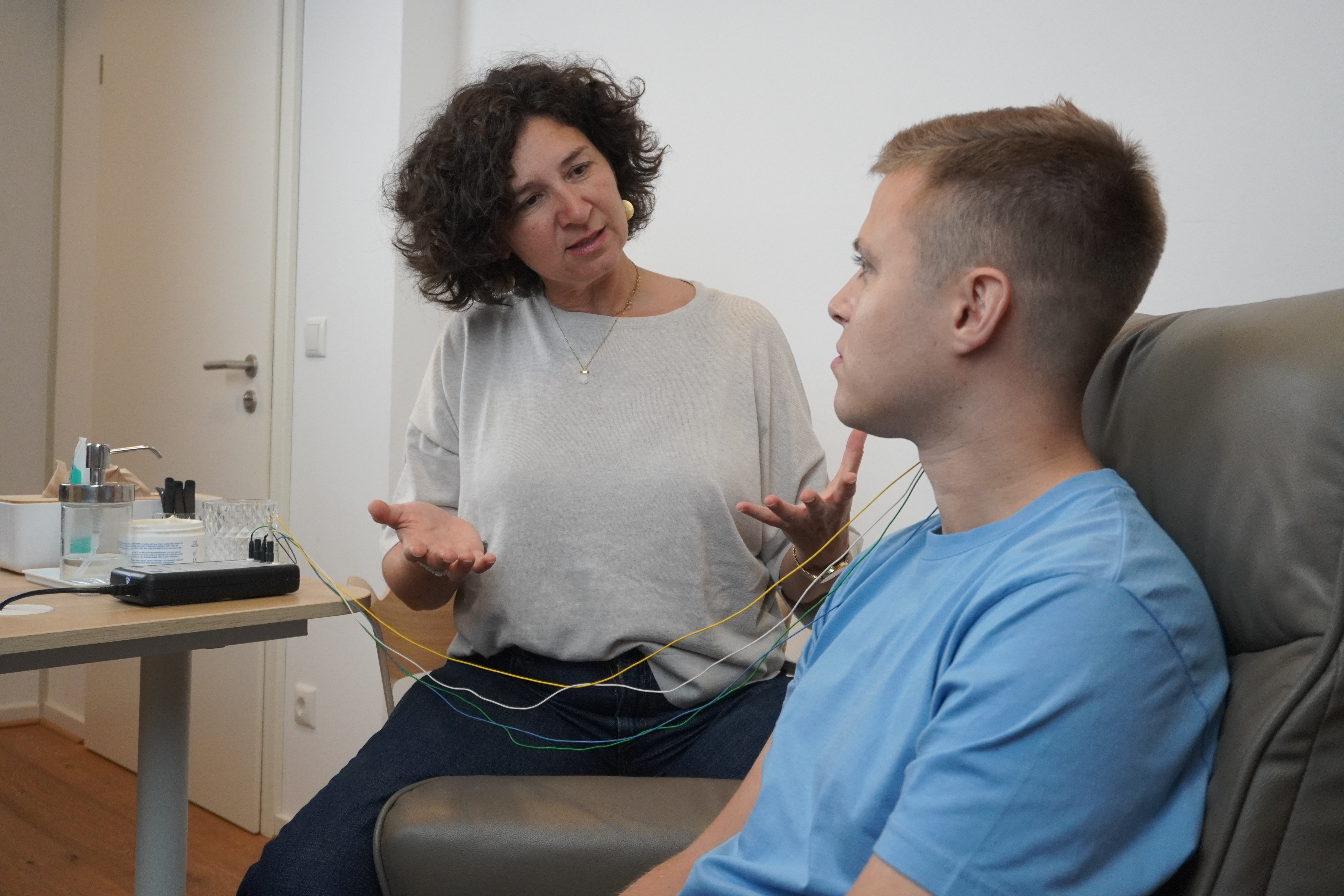
Neurofeedback is an evidence-based intervention that supports corporate wellness by strategically enhancing the brain’s capacity for self-regulation. Integrating it into the workplace offers three core benefits: It stabilizes the nervous system, helping employees manage chronic stress and efficiently transition into recovery states, thereby actively mitigating burnout risk. Furthermore, it improves essential metrics like sleep quality and boosts attention, executive function, and mental clarity, which are critical for sustained productivity. Finally, by developing self-regulation skills, Neurofeedback strengthens resilience and optimizes decision-making, enabling employees in high-stress roles to maintain peak performance.
1. Kanthak, M. K. et al. Autonomic dysregulation in burnout and depression: evidence for the central role of exhaustion. Scand. J. Work. Environ. Health 43, 475–484 (2017).
2. Golkar, A. et al. The influence of work-related chronic stress on the regulation of emotion and on functional connectivity in the brain. PloS One 9, e104550 (2014).
3. Dobrushina, O. R. et al. Modulation of Intrinsic Brain Connectivity by Implicit Electroencephalographic Neurofeedback. Front. Hum. Neurosci. 14, (2020).
4. de Matos, N. M. P., Stämpfli, P., Seifritz, E. & Brügger, M. Disassembling infra-low-frequency neurofeedback: A neurophysiological investigation of its feedback components. NeuroImage 325, 121647 (2026).
5. Akerstedt, T. Psychosocial stress and impaired sleep. Scand. J. Work. Environ. Health 32, 493–501 (2006).
6. Schabus, M. et al. Enhancing sleep quality and memory in insomnia using instrumental sensorimotor rhythm conditioning. Biol. Psychol. 95, 126–134 (2014).
7. Wu, Y. L., Fang, S. C., Chen, S. C., Tai, C. J. & Tsai, P. S. Effects of Neurofeedback on Fibromyalgia: A Randomized Controlled Trial. Pain Manag. Nurs. 22, 755–763 (2021).
8. Hoedlmoser, K. et al. Human SenSorimotor rHytHm, Sleep and Learning Instrumental Conditioning of Human Sensorimotor Rhythm (12-15 Hz) and Its Impact on Sleep as Well as Declarative Learning Instrumental Conditioning of Sensorimotor Rhythm-Hoedlmoser et Al. SLEEP vol. 31 (2008).
9. Kratzke, I. M. et al. Reducing Residents’ Burnout Using Neurofeedback. J. Am. Coll. Surg. 231, S254 (2020).
10. Othmer, S., Kara, O., Bechtereva, N. P. & Moore, P. T. Infra-Low Frequency Neurofeedback and Insomnia as a Model of CNS Dysregulation.
11. Benatti, B. et al. INTENSIVE NEUROFEEDBACK PROTOCOL: AN ALPHA TRAINING TO IMPROVE SLEEP QUALITY AND STRESS MODULATION IN HEALTH CARE PROFESSIONALS DURING THE COVID-19 PANDEMIC. A PILOT STUDY. Clin. Neuropsychiatry 20, 61–66 (2023).
12. Liu, C. & Cha, H. A randomized controlled trial for solving job stress of financial employees based on Neurofeedback training. NeuroQuantology 16, 91–96 (2018).
13. Shahyad, S. et al. Effectiveness of Neurofeedback on Psychological Stress, Salivary Cortisol and α-amylase Level in Students: A Randomized and Parallel-Group Clinical Trial. Iran. J. Psychiatry Behav. Sci. 18, (2024).
14. Iodice, P., Cannito, L., Chaigneau, A. & Palumbo, R. Learned self-regulation in top-level managers through neurobiofeedback training improves decision making under stress. Sci. Rep. 12, (2022).
15. Thompson, M. & Thompson, L. Neurofeedback for stress management. in Principles and practice of stress management, 3rd ed 249–287 (The Guilford Press, New York, NY, US, 2007).
16. Campbell, A. M., Mattoni, M., Yefimov, M. N., Adapa, K. & Mazur, L. M. Improving Cognitive Workload in Radiation Therapists: A Pilot EEG Neurofeedback Study. Front. Psychol. 11, (2020).
17. Egner, T. & Gruzelier, J. H. COGNITIVE NEUROSCIENCE AND NEUROPSYCHOLOGY NEUROREPORT Learned Self-Regulation of EEG Frequency Components Affects Attention and Event-Related Brain Potentials in Humans. Lippincott Williams & Wilkins vol. 12.
18. Lafont, A., Enriquez-Geppert, S., Roy, R., Leloup, V. & Dehais, F. Theta Neurofeedback and Pilots’ Executive Functioning.
19. Vernon, D. et al. The Effect of Training distinct Neurofeedback protocols on aspects of cognitive performance. Int. J. Psychophysiol. 47, 75–85 (2003).
20. Wilson, V., Peper, E. & Moss, D. ‘The Mind Room’ in Italian Soccer Training: The Use of Biofeedback and Neurofeedback for Optimum Performance Health Computing View Project Pathways Model for Healthcare View Project. https://www.researchgate.net/publication/259558691.
21. Smart Glasses Focus Attention with NASA Neurofeedback Technology - NASA. https://www.nasa.gov/technology/tech-transfer-spinoffs/smart-glasses-focus-attention-with-nasa-neurofeedback-technology/ (2020).