Patient information about Neurofeedback for your practice marketing — what matters

12. October 2020

In considering the flood of information about health services via the Internet, Apps and brochures, it is more important than ever to provide patients with specific and well-founded information. Patients' need for information is particularly high for Neurofeedback. After all, ‘What exactly happens if electrodes are attached to my or my child's head?’ is a more than justified question. However, reliable, comprehensible information is hard to find and serious medical offers are difficult to distinguish from those that are not. The patient flyers of BEE Medic offer a very good opportunity to explain Neurofeedback to your clients in a professional and understandable way.


Practical marketing — support for individual communication with patients

Practice marketing is not at all an easy task for many health professionals and therapeutic working groups. Always in a tense relationship between the economic necessity to market modern health services on the one hand and the regulations of advertising and competition law and the adherence to professional guidelines - which have to be considered - on the other hand. After all, health is our highest good and it is not appropriate to deal with promises of salvation lightly.

Certainly no easy terrain. The among PR and marketing professionals in Germany much quoted marketing principle  "Do good and talk about it", which goes back to a booktitle from 1961, is not so easy for practices to realize.

At this point, however, it should also be said that individual and active communication with the patient is the top priority for practices. No marketing tool in the world can replace empathy, your professional skills and direct communication with patients.

Neurofeedback is also a therapy method that is difficult to understand for a large proportion of patients. ‘What happens exactly with me?’, ‘Why do we need electrodes at the head?’, ‘Does it hurt?’ (here, for the sake of completeness: No, it does not) are typical questions. And especially in the field of mental health and working with young patients, personal communication is your most important means of building trust.

We are happy to support you with professional, targeted information. Patient flyers are a particularly simple and at the same time very efficient way of informing patients about your Neurofeedback services and giving them an initial orientation.

But how do you recognize good patient information?
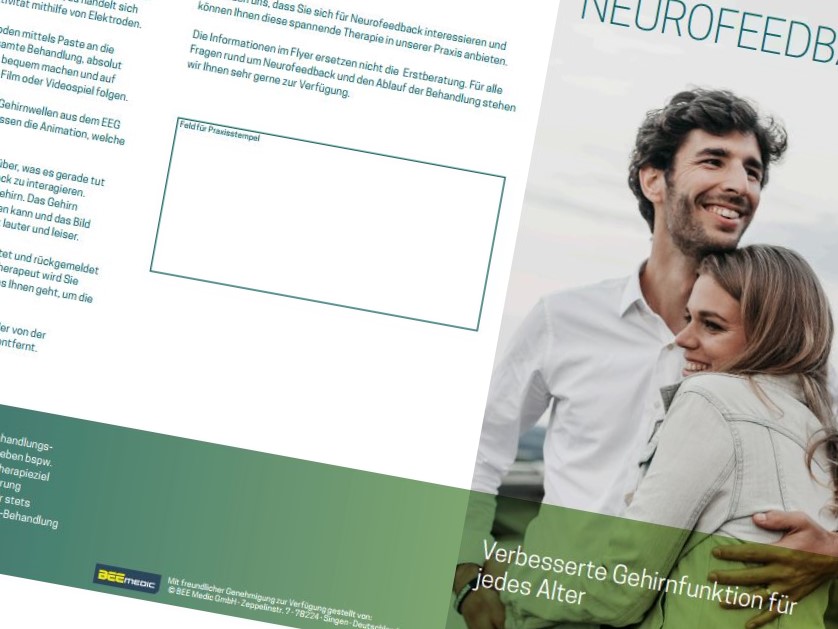
Neurofeedback Patienteninformation von der BEE Medic GmbH
Neurofeedback Patientenflyer der BEE Medic GmbH
Patient information - what is important

In short: Good information to patients focuses on patients and their questions rather than on a specific device, manufacturer or brand. You — not patients — need the therapeutic know-how, the advantages and details of a particular process or Neurofeedback system and the knowledge to integrate it in the therapeutic process.

Therefore, the information we provide to patients does not focus on any of our brands or products. Rather, we look at the following aspects:

  • How does the neurofeedback session work?
  • How does neurofeedback actually work?
  • Are there any requirements for neurofeedback therapy?
  • What do I have to consider during the therapy?

This information is complemented by references to important indications and specific therapeutic objectives.

You receive meaningful materials that support you in active patient communication and convey relevant knowledge to your clients in a short and understandable way.


Neurofeedback explained in an accessible way - here you can obtain up-to-date patient information

Customers of BEE Medic GmbH can order the Neurofeedback patient information directly via the webshop. The following patient information is currently available in the form of flyers in German and English:

  • Neurofeedback — improved brain function for all ages
  • Neurofeedback in ADHS — Information for ADHS patients and their families

A field for your practical stamp allows you to individualise the flyers. We would also be happy to provide you with a digital copy. Please contact the customer services of BEE Medic GmbH at [email protected] or [email protected].

Neurofeedback Grundkurs

Course description

Der Neurofeedback Grundkurs ist der ideale Einstieg ins Neurofeedback. In 5 Tagen lernen Sie alles, was Sie für den Start benötigen – vom Anlegen der Elektroden, über das Bedienen der Hard- und Software bis hin zur Auswahl der richtigen Behandlungsprotokolle, der Erstellung von Symptomprofilen und der Bewertung von Behandlungsergebnissen.

Einen zentralen Teil nimmt das tägliche Neurofeedback-Praktikum ein, bei dem Sie abwechselnd als „Therapeut/Therapeutin“ und „Patient/Patientin“ Neurofeedback selbst erfahren. Das Vorgehen und die Interpretation der Trainingsergebnisse werden für jeden einzelnen Teilnehmenden in Kleingruppen unter Leitung erfahrener Lehrpersonen diskutiert. So sind Sie nach Abschluss des Kurses in der Lage, sehr effizientes Neurofeedback direkt in der klinischen Praxis anzuwenden.

Das vollständige Neurofeedback Equipment stellen wir Ihnen während des Kurses zur Verfügung. Am Ende des Kurses findet ein Abschlusstest statt und Sie erhalten ein Zertifikat.

Einen Einblick in unsere Grundkurse erhalten Sie hier.

Essential teaching content

  • Technische Grundlagen des EEG und der Signalverarbeitung
  • 10-20 System und Elektrodenplatzierungen
  • Selbstregulierungsmodell und Neuroplastizität
  • Neurophysiologische Grundlagen zum Verständnis von Neurofeedback-Effekten
  • Umgang mit Neurofeedback-Hardware und Software sowie Artefakte erkennen
  • Muster von Fehlregulierungen im Zusammenhang mit physischen, emotionalen und Verhaltensproblemen erkennen
  • Neurofeedback-Protokolle für klinische und Peak Performance Anwendungen
  • Symptombewertung und Beurteilung von Trainingsverläufen
  • Neurofeedback und Medikamente
  • Kontraindikationen
  • Verlaufskontrolle und CPT – Continuous Performance Test
  • Neurofeedback-Praktikum, zur Selbsterfahrung wie schnell und spezifisch Neurofeedback-Effekte sein können

After the course you can

  • Sicher mit 2-Kanal ILF-Neurofeedback arbeiten und Ihre Patientinnen und Patienten nachhaltig mit Neurofeedback unterstützen
  • Behandlungsprotokolle gezielt nach Anlass und zu behandelnder Person auswählen und einsetzen
  • Patientinnen und Patienten zu einer besseren Selbstregulierung verhelfen und Symptome von psychischen Erkrankungen lindern, wovon meist auch weitere therapeutische Interventionen profitieren
  • Selbst von der angenehmen Arbeit mit Neurofeedback profitieren, durch eine gewisse „Leichtigkeit“, die Neurofeedback in den therapeutischen Arbeitsalltag bringt

Course highlights

  • Praktische Selbsterfahrung und hoher Praktikumsanteil
  • Intensive Betreuung durch erfahrene Dozierende in Kleingruppen
  • Bereitstellung des vollständigen Neurofeedback-Equipments und Verbrauchsmaterialien

Location

Hannover - DIAKOVERE Akademie
Anna-von-Borries-Straße 1-7
30625 Hannover
Germany

Period of time

30.11.2026 – 04.12.2026
30.11.2026 08:30 – 18:00
01.12.2026 08:30 – 18:00
02.12.2026 08:30 – 18:00
03.12.2026 08:30 – 18:00
04.12.2026 08:30 – 16:00
Local time: Europe/Berlin

Your selected time zone

Price

1.490,00 EUR

Included in the price

  • Bereitstellung des Neurofeedback-Equipments und von Verbrauchsmaterialien
  • Umfassende Kursunterlagen
  • Abschlussprüfung mit Zertifikat bei bestandener Prüfung

More Information

Der Kurs richtet sich exklusiv an heilberufliche und therapeutische Fachanwenderinnen und -anwender.

Gut zu wissen: 
Zur Buchung werden Sie direkt auf die Webseite der Diakovere Hannover weitergeleitet.

Language

  • German

Organizer

Diakovere GmbH Akademie
Anna-von-Borries-Straße 1-7
30625 Hannover
Deutschland

register* Print course description *By clicking on "register" you will be forwarded directly to the organizer of the course for booking. The organizer is also responsible for course organisation and invoicing.
 

Neurofeedback Grundkurs

Course description

Der Neurofeedback Grundkurs ist der ideale Einstieg ins Neurofeedback. In 5 Tagen lernen Sie alles, was Sie für den Start benötigen – vom Anlegen der Elektroden, über das Bedienen der Hard- und Software bis hin zur Auswahl der richtigen Behandlungsprotokolle, der Erstellung von Symptomprofilen und der Bewertung von Behandlungsergebnissen.

Einen zentralen Teil nimmt das tägliche Neurofeedback-Praktikum ein, bei dem Sie abwechselnd als „Therapeut/Therapeutin“ und „Patient/Patientin“ Neurofeedback selbst erfahren. Das Vorgehen und die Interpretation der Trainingsergebnisse werden für jeden einzelnen Teilnehmenden in Kleingruppen unter Leitung erfahrener Lehrpersonen diskutiert. So sind Sie nach Abschluss des Kurses in der Lage, sehr effizientes Neurofeedback direkt in der klinischen Praxis anzuwenden.

Das vollständige Neurofeedback Equipment stellen wir Ihnen während des Kurses zur Verfügung. Am Ende des Kurses findet ein Abschlusstest statt und Sie erhalten ein Zertifikat.

Einen Einblick in unsere Grundkurse erhalten Sie hier.

Essential teaching content

  • Technische Grundlagen des EEG und der Signalverarbeitung
  • 10-20 System und Elektrodenplatzierungen
  • Selbstregulierungsmodell und Neuroplastizität
  • Neurophysiologische Grundlagen zum Verständnis von Neurofeedback-Effekten
  • Umgang mit Neurofeedback-Hardware und Software sowie Artefakte erkennen
  • Muster von Fehlregulierungen im Zusammenhang mit physischen, emotionalen und Verhaltensproblemen erkennen
  • Neurofeedback-Protokolle für klinische und Peak Performance Anwendungen
  • Symptombewertung und Beurteilung von Trainingsverläufen
  • Neurofeedback und Medikamente
  • Kontraindikationen
  • Verlaufskontrolle und CPT – Continuous Performance Test
  • Neurofeedback-Praktikum, zur Selbsterfahrung wie schnell und spezifisch Neurofeedback-Effekte sein können

After the course you can

  • Sicher mit 2-Kanal ILF-Neurofeedback arbeiten und Ihre Patientinnen und Patienten nachhaltig mit Neurofeedback unterstützen
  • Behandlungsprotokolle gezielt nach Anlass und zu behandelnder Person auswählen und einsetzen
  • Patientinnen und Patienten zu einer besseren Selbstregulierung verhelfen und Symptome von psychischen Erkrankungen lindern, wovon meist auch weitere therapeutische Interventionen profitieren
  • Selbst von der angenehmen Arbeit mit Neurofeedback profitieren, durch eine gewisse „Leichtigkeit“, die Neurofeedback in den therapeutischen Arbeitsalltag bringt

Location

Dornstadt - Diakonisches Institut für soziale Berufe
Bodelschwinghweg 30
89160 Dornstadt
Germany

Period of time

13.07.2026 – 17.07.2026
13.07.2026 08:30 – 18:00
14.07.2026 08:30 – 18:00
15.07.2026 08:30 – 18:00
16.07.2026 08:30 – 18:00
17.07.2026 08:30 – 16:00
Local time: Europe/Berlin

Your selected time zone

Price

1.190,00 EUR

Included in the price

  • Bereitstellung des Neurofeedback-Equipments und von Verbrauchsmaterialien
  • Umfassende Kursunterlagen
  • Abschlussprüfung mit Zertifikat bei bestandener Prüfung

More Information

Der Kurs richtet sich exklusiv an heilberufliche und therapeutische Fachanwenderinnen und -anwender.
 

Gut zu wissen: Zur Buchung werden Sie direkt auf die Webseite des Diakonischen Instituts Dornstadt weitergeleitet.

Language

  • German

Organizer

Diakonisches Institut für soziale Berufe
Bodelschwinghweg 30
89160 Dornstadt
Deutschland


register* Print course description *By clicking on "register" you will be forwarded directly to the organizer of the course for booking. The organizer is also responsible for course organisation and invoicing.
 

Neurofeedback Grundkurs

Course description

Der Neurofeedback Grundkurs ist der ideale Einstieg ins Neurofeedback. In 5 Tagen lernen Sie alles, was Sie für den Start benötigen – vom Anlegen der Elektroden, über das Bedienen der Hard- und Software bis hin zur Auswahl der richtigen Behandlungsprotokolle, der Erstellung von Symptomprofilen und der Bewertung von Behandlungsergebnissen.

Einen zentralen Teil nimmt das tägliche Neurofeedback-Praktikum ein, bei dem Sie abwechselnd als „Therapeut“ und „Patient“ Neurofeedback selbst erfahren. Das Vorgehen und die Interpretation der Trainingsergebnisse werden für jeden einzelnen Teilnehmer in Kleingruppen unter Leitung erfahrener Dozenten diskutiert. So sind Sie nach Abschluss des Kurses in der Lage, sehr effizientes Neurofeedback direkt in der klinischen Praxis anzuwenden.

Das vollständige Neurofeedback Equipment stellen wir Ihnen während des Kurses zur Verfügung. Am Ende des Kurses findet ein Abschlusstest statt und Sie erhalten ein Zertifikat.

Einen Einblick in unsere Grundkurse erhalten Sie hier.

Essential teaching content

  • Technische Grundlagen des EEG und der Signalverarbeitung
  • 10-20 System und Elektrodenplatzierungen
  • Selbstregulierungsmodell und Neuroplastizität
  • Neurophysiologische Grundlagen zum Verständnis von Neurofeedback-Effekten Umgang mit Neurofeedback Hardware und Software sowie Artefakte erkennen
  • Muster von Fehlregulierungen im Zusammenhang mit physischen, emotionalen und Verhaltensproblemen erkennen Neurofeedback Protokolle für klinische und Peak Performance Anwendungen
  • Symptombewertung und Beurteilung von Trainingsverläufen
  • Neurofeedback und Medikamente
  • Kontraindikationen
  • Verlaufskontrolle und CPT – Continuous Performance Test
  • Neurofeedback-Praktikum, zur Selbsterfahrung wie schnell und spezifisch Neurofeedback-Effekte sein können

After the course you can

  • Sicher mit 2-Kanal ILF-Neurofeedback arbeiten und Ihre Klienten nachhaltig mit Neurofeedback unterstützen
  • Behandlungsprotokolle gezielt nach Anlass und Klient auswählen und einsetzen
  • Klienten zu einer besseren Selbstregulierung verhelfen und Symptome von psychischen Erkrankungen lindern, wovon meist auch weitere therapeutische Interventionen profitieren
  • Selbst von der angenehmen Arbeit mit Neurofeedback profitieren, durch eine gewisse „Leichtigkeit“, die Neurofeedback in den therapeutischen Arbeitsalltag bringt

Location

Regensburg - Döpfer Akademie
Galgenbergstraße 2 b
93053 Regensburg
Germany

Period of time

02.11.2026 – 06.11.2026
02.11.2026 08:30 – 18:00
03.11.2026 08:30 – 18:00
04.11.2026 08:30 – 18:00
05.11.2026 08:30 – 18:00
06.11.2026 08:30 – 16:00
Local time: Europe/Berlin

Your selected time zone

Price

1.390,00 EUR

Included in the price

  • Bereitstellung des Neurofeedback-Equipments und von Verbrauchsmaterialien
  • Umfassende Kursunterlagen
  • Abschlussprüfung mit Zertifikat bei bestandener Prüfung

More Information

Der Kurs richtet sich exklusiv an heilberufliche und therapeutische Fachanwenderinnen und -anwender.

Gut zu wissen: 
Zur Buchung werden Sie direkt auf die Webseite der Döpfer Akademie weitergeleitet.

Language

  • German

Organizer

Döpfer Akademie, Fort- und Weiterbildung e.K.
Klosterstraße 25
92421 Schwandorf
Germany

register* Print course description *By clicking on "register" you will be forwarded directly to the organizer of the course for booking. The organizer is also responsible for course organisation and invoicing.
 

Neurofeedback Grundkurs

Course description

Der Neurofeedback Grundkurs ist der ideale Einstieg ins Neurofeedback. In 5 Tagen lernen Sie alles, was Sie für den Start benötigen – vom Anlegen der Elektroden, über das Bedienen der Hard- und Software bis hin zur Auswahl der richtigen Behandlungsprotokolle, der Erstellung von Symptomprofilen und der Bewertung von Behandlungsergebnissen.

Einen zentralen Teil nimmt das tägliche Neurofeedback-Praktikum ein, bei dem Sie abwechselnd als „Therapeut/Therapeutin“ und „Patient/Patientin“ Neurofeedback selbst erfahren. Das Vorgehen und die Interpretation der Trainingsergebnisse werden für jeden einzelnen Teilnehmenden in Kleingruppen unter Leitung erfahrener Lehrpersonen diskutiert. So sind Sie nach Abschluss des Kurses in der Lage, sehr effizientes Neurofeedback direkt in der klinischen Praxis anzuwenden.

Das vollständige Neurofeedback Equipment stellen wir Ihnen während des Kurses zur Verfügung. Am Ende des Kurses findet ein Abschlusstest statt und Sie erhalten ein Zertifikat.

Einen Einblick in unsere Grundkurse erhalten Sie hier.

Essential teaching content

  • Technische Grundlagen des EEG und der Signalverarbeitung
  • 10-20 System und Elektrodenplatzierungen
  • Selbstregulierungsmodell und Neuroplastizität
  • Neurophysiologische Grundlagen zum Verständnis von Neurofeedback-Effekten
  • Umgang mit Neurofeedback-Hardware und Software sowie Artefakte erkennen
  • Muster von Fehlregulierungen im Zusammenhang mit physischen, emotionalen und Verhaltensproblemen erkennen
  • Neurofeedback-Protokolle für klinische und Peak Performance Anwendungen
  • Symptombewertung und Beurteilung von Trainingsverläufen
  • Neurofeedback und Medikamente
  • Kontraindikationen
  • Verlaufskontrolle und CPT – Continuous Performance Test
  • Neurofeedback-Praktikum, zur Selbsterfahrung wie schnell und spezifisch Neurofeedback-Effekte sein können

After the course you can

  • Sicher mit 2-Kanal ILF-Neurofeedback arbeiten und Ihre Patientinnen und Patienten nachhaltig mit Neurofeedback unterstützen
  • Behandlungsprotokolle gezielt nach Anlass und zu behandelnder Person auswählen und einsetzen
  • Patientinnen und Patienten zu einer besseren Selbstregulierung verhelfen und Symptome von psychischen Erkrankungen lindern, wovon meist auch weitere therapeutische Interventionen profitieren
  • Selbst von der angenehmen Arbeit mit Neurofeedback profitieren, durch eine gewisse „Leichtigkeit“, die Neurofeedback in den therapeutischen Arbeitsalltag bringt

Course highlights

  • Praktische Selbsterfahrung und hoher Praktikumsanteil
  • Intensive Betreuung durch erfahrene Dozierende in Kleingruppen
  • Bereitstellung des vollständigen Neurofeedback-Equipments und Verbrauchsmaterialien

Location

Rheine - Döpfer Akademie
Salzbergener Straße 13
48431 Rheine
Germany

Period of time

07.09.2026 – 11.09.2026
07.09.2026 08:30 – 18:00
08.09.2026 08:30 – 18:00
09.09.2026 08:30 – 18:00
10.09.2026 08:30 – 18:00
11.09.2026 08:30 – 16:00
Local time: Europe/Berlin

Your selected time zone

Price

1.390,00 EUR

Included in the price

  • Bereitstellung des Neurofeedback-Equipments und von Verbrauchsmaterialien
  • Umfassende Kursunterlagen
  • Abschlussprüfung mit Zertifikat bei bestandener Prüfung

More Information

Der Kurs richtet sich exklusiv an heilberufliche und therapeutische Fachanwenderinnen und -anwender.

Gut zu wissen: 
Zur Buchung werden Sie direkt auf die Webseite der Döpfer Akademie weitergeleitet.

Language

  • German

Organizer

Döpfer Akademie, Fort- und Weiterbildung e.K.
Klosterstraße 25
92421 Schwandorf
Germany

register* Print course description *By clicking on "register" you will be forwarded directly to the organizer of the course for booking. The organizer is also responsible for course organisation and invoicing.
 

Neurofeedback Grundkurs

Course description

Der Neurofeedback Grundkurs ist der ideale Einstieg ins Neurofeedback. In 5 Tagen lernen Sie alles, was Sie für den Start benötigen – vom Anlegen der Elektroden, über das Bedienen der Hard- und Software bis hin zur Auswahl der richtigen Behandlungsprotokolle, der Erstellung von Symptomprofilen und der Bewertung von Behandlungsergebnissen.

Einen zentralen Teil nimmt das tägliche Neurofeedback-Praktikum ein, bei dem Sie abwechselnd als „Therapeut“ und „Patient“ Neurofeedback selbst erfahren. Das Vorgehen und die Interpretation der Trainingsergebnisse werden für jeden einzelnen Teilnehmer in Kleingruppen unter Leitung erfahrener Dozenten diskutiert. So sind Sie nach Abschluss des Kurses in der Lage, sehr effizientes Neurofeedback direkt in der klinischen Praxis anzuwenden.

Das vollständige Neurofeedback Equipment stellen wir Ihnen während des Kurses zur Verfügung. Am Ende des Kurses findet ein Abschlusstest statt und Sie erhalten ein Zertifikat.

Einen Einblick in unsere Grundkurse erhalten Sie hier.

Essential teaching content

  • Technische Grundlagen des EEG und der Signalverarbeitung
  • 10-20 System und Elektrodenplatzierungen
  • Selbstregulierungsmodell und Neuroplastizität
  • Neurophysiologische Grundlagen zum Verständnis von Neurofeedback-Effekten Umgang mit Neurofeedback Hardware und Software sowie Artefakte erkennen
  • Muster von Fehlregulierungen im Zusammenhang mit physischen, emotionalen und Verhaltensproblemen erkennen Neurofeedback Protokolle für klinische und Peak Performance Anwendungen
  • Symptombewertung und Beurteilung von Trainingsverläufen
  • Neurofeedback und Medikamente
  • Kontraindikationen
  • Verlaufskontrolle und CPT – Continuous Performance Test
  • Neurofeedback-Praktikum, zur Selbsterfahrung wie schnell und spezifisch Neurofeedback-Effekte sein können

After the course you can

  • Sicher mit 2-Kanal ILF-Neurofeedback arbeiten und Ihre Klienten nachhaltig mit Neurofeedback unterstützen
  • Behandlungsprotokolle gezielt nach Anlass und Klient auswählen und einsetzen
  • Klienten zu einer besseren Selbstregulierung verhelfen und Symptome von psychischen Erkrankungen lindern, wovon meist auch weitere therapeutische Interventionen profitieren
  • Selbst von der angenehmen Arbeit mit Neurofeedback profitieren, durch eine gewisse „Leichtigkeit“, die Neurofeedback in den therapeutischen Arbeitsalltag bringt

Location

Hamburg - Döpfer Akademie
Friedrich-Ebert-Damm 143
22047 Hamburg
Germany

Period of time

20.07.2026 – 24.07.2026
20.07.2026 08:30 – 18:00
21.07.2026 08:30 – 18:00
22.07.2026 08:30 – 18:00
23.07.2026 08:30 – 18:00
24.07.2026 08:30 – 16:00
Local time: Europe/Berlin

Your selected time zone

Price

1.390,00 EUR

Included in the price

  • Bereitstellung des Neurofeedback-Equipments und von Verbrauchsmaterialien
  • Umfassende Kursunterlagen
  • Abschlussprüfung mit Zertifikat bei bestandener Prüfung

Language

  • German

Organizer

Döpfer Akademie, Fort- und Weiterbildung e.K.
Klosterstraße 25
92421 Schwandorf
Germany

register* Print course description *By clicking on "register" you will be forwarded directly to the organizer of the course for booking. The organizer is also responsible for course organisation and invoicing.
 

Neurofeedback Grundkurs

Course description

Der Neurofeedback Grundkurs ist der ideale Einstieg ins Neurofeedback. In 5 Tagen lernen Sie alles, was Sie für den Start benötigen – vom Anlegen der Elektroden, über das Bedienen der Hard- und Software bis hin zur Auswahl der richtigen Behandlungsprotokolle, der Erstellung von Symptomprofilen und der Bewertung von Behandlungsergebnissen.

Einen zentralen Teil nimmt das tägliche Neurofeedback-Praktikum ein, bei dem Sie abwechselnd als „Therapeut/Therapeutin“ und „Patient/Patientin“ Neurofeedback selbst erfahren. Das Vorgehen und die Interpretation der Trainingsergebnisse werden für jeden einzelnen Teilnehmenden in Kleingruppen unter Leitung erfahrener Lehrpersonen diskutiert. So sind Sie nach Abschluss des Kurses in der Lage, sehr effizientes Neurofeedback direkt in der klinischen Praxis anzuwenden.

Das vollständige Neurofeedback Equipment stellen wir Ihnen während des Kurses zur Verfügung. Am Ende des Kurses findet ein Abschlusstest statt und Sie erhalten ein Zertifikat.

Einen Einblick in unsere Grundkurse erhalten Sie hier.

Essential teaching content

  • Technische Grundlagen des EEG und der Signalverarbeitung
  • 10-20 System und Elektrodenplatzierungen
  • Selbstregulierungsmodell und Neuroplastizität
  • Neurophysiologische Grundlagen zum Verständnis von Neurofeedback-Effekten
  • Umgang mit Neurofeedback-Hardware und Software sowie Artefakte erkennen
  • Muster von Fehlregulierungen im Zusammenhang mit physischen, emotionalen und Verhaltensproblemen erkennen
  • Neurofeedback-Protokolle für klinische und Peak Performance Anwendungen
  • Symptombewertung und Beurteilung von Trainingsverläufen
  • Neurofeedback und Medikamente
  • Kontraindikationen
  • Verlaufskontrolle und CPT – Continuous Performance Test
  • Neurofeedback-Praktikum, zur Selbsterfahrung wie schnell und spezifisch Neurofeedback-Effekte sein können

After the course you can

  • Sicher mit 2-Kanal ILF-Neurofeedback arbeiten und Ihre Patientinnen und Patienten nachhaltig mit Neurofeedback unterstützen
  • Behandlungsprotokolle gezielt nach Anlass und zu behandelnder Person auswählen und einsetzen
  • Patientinnen und Patienten zu einer besseren Selbstregulierung verhelfen und Symptome von psychischen Erkrankungen lindern, wovon meist auch weitere therapeutische Interventionen profitieren
  • Selbst von der angenehmen Arbeit mit Neurofeedback profitieren, durch eine gewisse „Leichtigkeit“, die Neurofeedback in den therapeutischen Arbeitsalltag bringt

Location

Düsseldorf - Döpfer Akademie
Werdenerstr.8
40227 Düsseldorf
Germany

Period of time

29.06.2026 – 03.07.2026
29.06.2026 08:30 – 18:00
30.06.2026 08:30 – 18:00
01.07.2026 08:30 – 18:00
02.07.2026 08:30 – 18:00
03.07.2026 08:30 – 16:00
Local time: Europe/Berlin

Your selected time zone

Price

1.390,00 EUR

Included in the price

  • Bereitstellung des Neurofeedback-Equipments und von Verbrauchsmaterialien
  • Umfassende Kursunterlagen
  • Abschlussprüfung mit Zertifikat bei bestandener Prüfung

More Information

Der Kurs richtet sich exklusiv an heilberufliche und therapeutische Fachanwenderinnen und -anwender.

Gut zu wissen: 
Zur Buchung werden Sie direkt auf die Webseite der Döpfer Akademie weitergeleitet.

Language

  • German

Organizer

Döpfer Akademie, Fort- und Weiterbildung e.K.
Klosterstraße 25
92421 Schwandorf
Germany

register* Print course description *By clicking on "register" you will be forwarded directly to the organizer of the course for booking. The organizer is also responsible for course organisation and invoicing.
 

Study proves: just one session with ILF Neurofeedback results in significant changes in brain connectivity!

10. September 2020

For the first time a randomized, controlled study has shown effects of Infra Low Frequency Neurofeedback (ILF Neurofeedback for short and also known as the Othmer method), on connectivity and brain activity - and this after only a single session. The study by Dobrushina et al. entitled "Modulation of Intrinsic Brain Connectivity by Implicit Electroencephalographic Neurofeedback" thus makes an important contribution to a better understanding of the mechanisms and processes of ILF Neurofeedback. “This confirms what we see in daily practice and what patients telling us: that ILF Neurofeedback has effects even after only one session,” says Dr. Bernhard Wandernoth, Founder of BEE Medic GmbH.

Dobrushina et al. (2020). Modulation of Intrinsic Brain Connectivity by Implicit Electroencephalographic Neurofeedback. Frontiers in Human Neuroscience, 14:192


Detection of a change in brain connectivity by 30 minutes ILF Neurofeedback

The human brain consists of about 100 billion nerve cells, which form extremely complex networks via so-called synaptic connections. neuronal compounds (connective) develop and change dynamically. Every functional change in the brain is accompanied by changes in the connectivity of nerve cells. Using functional magnetic resonance imaging (fMRI), Dobrushina and colleagues have now been able to show for the first time that ILF Neurofeedback modulates significant changes in brain connectivity.


Investigation on 52 probands

The 52 healthy probands completed a 30-minute ILF Neurofeedback session (electrode position: T4/P4) in a double-blind, controlled experimental design. Half of the test persons (control group) received sham Neurofeedback, in which the animations were generated randomly and were not the result of brain waves. Before and after the Neurofeedback session, the activity of neuronal networks in the brain was recorded in all subjects using functional magnetic resonance imaging (fMRI) at rest.


Special feature of ILF Neurofeedback: Implicit processing of the feedback signal modulates neuronal networks and increases connectivity

A special feature of ILF Neurofeedback is that the feedback signal is not consciously altered but implicitly processed, which is assumed to modulate neuronal networks involved in the self-regulation of the brain. A comparison of the fMRI images before and after ILF Neurofeedback shows the activation of a network of several regions in the brain, which is associated with the implicit Neurofeedback process and is formed immediately after the ILF Neurofeedback session. Some of the regions involved in the network have key functions in processes of control, visual perception and implicit learning. In addition, post Neurofeedback recordings show increased connectivity between brain regions associated with stimulus perception (salience), speech and visual networks, i.e. multi-sensory information processing and integration. This increased connectivity is only seen in the experimental group but not in the control group, suggesting that the increased connectivity is an effect of Neurofeedback.


An important milestone in the understanding of Neurofeedback

"The work of Olga Dobrushina is an important basis for further studies. The result is significant, is being appreciatively discussed by high-ranking neuroscientists and a follow-up study has already started", says Dr. Bernhard Wandernoth and continues: "Of course, I am especially pleased about the confirmation of what drives us every day, what we have been observing for years and what we get back from therapists and patients. After all, it has always been our goal to develop Neurofeedback procedures and technologies in a way that we achieve the greatest possible effects, so that patients and therapists are enthusiastic. The study now makes an important contribution to further research into the mode of action of Neurofeedback and the development of explanatory models. Above all, the study also shows the role of ILF Neurofeedback and the potential of this individual and effective Neurofeedback approach. We will continue to push the development of modern neurofeedback. Most importantly, the study also shows what role ILF Neurofeedback is playing and the potential of this individual and effective Neurofeedback approach. The fact that we can look back to 35 years of intensive cooperation between clinicians, scientists and developers and which has resulted in empirical clinical work of hundreds of thousands and more Neurofeedback sessions, have now succeeded in gaining a first impression of what Neurofeedback actually does in the brain. And this is definitely a milestone for a better understanding of Neurofeedback in general.”

6 reasons for online Neurofeedback training

18. August 2020

The increasing digitalization brings us many advantages in everyday life. However, especially when it comes to e-learning and in particular to professional and medical training, there are often concerns as to whether further education can really work online. 

With the online courses with training providers accredited by us, we have already convinced numerous of our customers. Of course, this is also a question of character, but with the following six reasons for digital learning, we would like to show you the advantages of online courses.

1. The technique: Online training works easily

When it comes to digital learning, questions about technical equipment often arise first. "Is my technical knowledge adequate to complete the course?", "Do I have the necessary technical equipment ?" and "What software do I need?" we are often asked.

This is not surprising, because especially in the field of mental health you work primarily with people and not on the PC. And a few years ago you might have had to install programs. Fortunately, this is no longer necessary today.

To take part in an online course you only need a PC or laptop with a steady internet connection. Of course, a webinar software is still required to allow several people to participate in a online course at the same time. You will see, we make sure that everything works perfectly. You do not have to worry about it.

When selecting the webinar software, we therefore pay attention to the following aspects:

  • You do not need to install or download new programs or special software
  • You simply need an internet connection and you will receive a link from us which will take you to the course with just one click
  • We only use professional, well-proven software
  • And we pay attention to the protection of your data

Technical support is available during the whole online course and can be reached at any time by phone, chat or e-mail. And for a relaxed start on the course day, we usually offer individual "pre-tests" 3 days before the course, in which a support employee checks the technology with you and shows all functions such as video and microphone settings.

Nahaufnahme Person am Laptop während eines Webinars

2. Special group dynamics in the online course

Learning together connects. Everyone of us knows that. Usually you quickly notice if you feel comfortable in a course, with the lecturer and with the other participants and a specific group dynamic develops.

This is exactly what happens online, too. Because most participants may have already attended a webinar, but only have little experience with online courses lasting several days. This brings people together automatically. And often getting to know each other via monitor is very interesting: you are curious to see how the others are doing, you will be proud when everything is running smoothly and you gains insights into other practices and rooms - which can be more exciting and personal than coming together at a "neutral course location". Despite the physical distance, there is a fairly personal exchange, because you give insights into your personal environment and at the same time your are feeling very familiar.

At any time during the course you can see the lecturers and, depending on the screen settings, the other participants; you can talk and ask questions - just like in a face-to-face meeting. The advantage is that you can also deactivate your camera at any time.

3. online learning with a varied course concept

With the online courses with training providers accredited by us, you don't have to sit in front of your PC or laptop all day. Apart from presentations, the online course also includes:

  • discussions
  • workshops in small groups in virtual classrooms
  • film sequences
  • and the practical training

And of course there are regular, sufficient breaks, which you can spend at your favourite Italian restaurant around the corner. You can stretch your legs, do little things, greet the children from school or exchange ideas with other course participants.

4. Planning reliability and time savings

Online courses offer you planning security. The courses take place regardless of any regional or national travel or assembly restrictions or quarantine requirements. You also minimise your risk of infection. In particular, you save time by eliminating travel time. You will not have to travel the day before the course, which is usually necessary, nor will you have to make the return journey after several days, which is often considered to be particularly long. In addition, the cost of food and accommodation is reduced compared to a location-bound course. Rather, you can also process what you have learned in familiar surroundings after the individual seminar days.

5. Free use of the Neurofeedback equipment during the whole course

During the online courses, you practise with the Neurofeedback systems of BEE Medic GmbH, the NeuroAmp® amplifier and Cygnet® Neurofeedback software. In advanced and indicator-specific courses, you usually already have a system in place and can easily use it for the practical part, as well as for local courses, where many participants usually have their own system. For the Neurofeedback online basic courses, you can buy a complete system before the course starts. The advantage is that you can practice during the course and you can start immediately after the course in your practice. You can also borrow a free complete system for trying and testing during the course.

6. Train several employees or colleagues with little effort

Online training courses are ideal for group practices and if you want to learn neurofeedback together with colleagues. Several employees or colleagues can be trained simultaneously. The time off for the course can be well planned and is limited. There are also no costs for travel and accommodation. In 2020 you will also benefit from an attractive discount campaign.

Get more information and book now

E-learning in the medical field may still be new to many people, but you can see that there are also some arguments in favour of digital learning. Innovative e-learning concepts guarantee personal exchange and professional education at a high level.

In our course overview you will find numerous online courses for 2020, ranging from one to two-day advanced courses to our 5-day Neurofeedback Basic Courses, which you can either complete in one go or on two consecutive weekends.


Subscribe to