Annual Conference for Applied Neurofeedback (ACAN) 2024

18. January 2024

We are delighted to announce that the Annual Conference for Applied Neurofeedback is back for a second year!

Taking place from 7-8 June in Bucharest, Romania, this networking event promises to be once again a platform for knowledge exchange, collaboration and innovation. Leading international experts, such as Siegfried Othmer and Roxana Sasu, will share their knowledge and present and discuss various topics in the field of Neurofeedback. The conference will offer a wide range of presentations, workshops and panel discussions - suitable for everyone, whether you are an expert in the field or someone curious about the potential of Neurofeedback.


acan2024

Experts, researchers and enthusiasts will come together to explore the latest advances in this rapidly growing field. In addition, the conference offers ample networking opportunities. Attendees will have the chance to connect with like-minded professionals, exchange ideas and foster collaborations.
 

Become a part of the special Neurofeedback community and get your ticket here. Don’t miss out: Early Bird Tickets are available until March 7. More information on speakers and topics will be posted soon - so keep an eye on our website!
 

Christmas giveaway - Take your chance to win the bestseller "The Body Keeps The Score" by Bessel van der Kolk

27. November 2023

The festive season is here and with it the perfect opportunity to cosy up with a cup of hot chocolate. Of course, an exciting read is a must!
We would like to brighten up the festive season and are giving away a copy of the bestseller "The Body Keeps The Score" by Bessel van der Kolk. 


We are also giving away the German version of the book. To enter, please click here.


Bessel van der Kolk, renowned psychiatrist and trauma expert, is the founder of the Trauma Centre in Brookline, Massachusetts. He has received several awards and honours for his significant contributions to trauma research and therapy. In "The Body Keeps The Score", van der Kolk opens up a new understanding of the causes and consequences of trauma. In it, he discusses various therapeutic approaches for the treatment of trauma-related disorders. Neurofeedback is one of the techniques he writes about.


This is how you can take part in the giveaway:
Fill out this form to register for our newsletter. You will then receive an e-mail within the next two working days in which you must confirm your registration for the newsletter. Once you have done this, you are already in the lottery pot!
Are you already a customer and already receive our newsletter? No problem, please also follow the steps described above. You will not receive the newsletter twice. 
You can take part until 15 December, 12 a.m. CET.
 
What happens after that?
The winners will then be informed promptly by e-mail about the prize. Please note that we will then also need your address details so that we can send the book to you! Only one entry per person is possible. However, you are very welcome to refer interested colleagues to this competition and thus perhaps also increase the chances that a copy of this book will soon be available in your practice.

Gemütlich lesen

Conditions of participation:
The competition is organised by BEE Medic GmbH. Further information can be found in the legal notice.
Participation requires that you have your place of residence, registered office or place of habitual residence in the region(s) listed below: European Union, Switzerland, UK, USA, Canada
Participation is possible from the age of 18
Payment of the prize in cash or in kind, its exchange or transfer to other persons is not possible.
Employees of BEE Medic GmbH and affiliated companies as well as employees of the companies providing the prize are excluded from participation. Furthermore, all persons who are or were involved in the creation or organisation of the competition, as well as their spouses or partners.
If the winners do not respond within 4 weeks of being contacted, we reserve the right to give the prize away to another person.
We would also like to point out that the competition and the prizes are voluntary services on our part, for which the same scope of warranty and liability does not apply as, for example, in the case of a purchase of the raffled prizes independent of the competition. 
The competition can be cancelled at any time and for any reason.
All conditions of participation can be found here.

Aktionswoche der Seelischen Gesundheit bei BEE Medic

28. September 2023

Vom 10. bis 20. Oktober 2023 setzt sich die Aktionswoche der Seelischen Gesundheit unter dem Motto „Zusammen der Angst das Gewicht nehmen” mit dem Thema Ängste in Krisenzeiten auseinander. Das Aktionsbündnis Seelische Gesundheit verfolgt das Ziel,  auf die unterschiedlichen Strategien zur Bewältigung und auf das vielfältige psychosoziale Hilfsangebot in Deutschland aufmerksam zu machen sowie mentale Erkrankungen zu entstigmatisieren.


Steigender Bedarf an psychologischer Unterstützung


Studien zeigen, dass psychische Erkrankungen, darunter auch Angststörungen, und demzufolge der Bedarf an psychologischer Unterstützung immer mehr ansteigt. Verstärkt wird dies durch Krisen, wie beispielsweise die Corona-Pandemie. So zeigt eine Studie der DAK (1), dass im Jahr 2022 ein Höchststand an Fehltagen aufgrund psychischer Erkrankungen, wie Depressionen, Anpassungs- und Belastungsstörungen, chronische Erschöpfung oder Angststörung, zu verzeichnen ist. Eine weitere Studie der Krankenkasse (2) zeigt einen deutlichen Anstieg von  Angststörungen und Depressionen bei Jugendlichen während bzw. nach der Pandemie. Demzufolge sei die Prävalenz von Angststörungen bei Jugendlichen im Jahr 2021, im Vergleich zum Jahr 2019, um ca. 59% gestiegen. Weiterhin wurden 25% mehr Jugendliche verzeichnet, welcher mit depressiven Episoden versorgt wurden.


Generell brauchten während der Corona-Pandemie mehr Menschen psychologische Hilfe. So stellten beispielsweise 82% der Ärzt:innen bei ihren Patient:innen häufiger Probleme mit Angststörungen fest. Etwa 80% der Ärzt:innen diagnostizieren Depressionen häufiger als vor der Corona-Pandemie. Ebenfalls sind die psychosomatischen Beschwerden angestiegen, wie bspw. Müdigkeit, Erschöpfung oder Schmerzen ohne organische Ursache (3). Parallel zu dieser Entwicklung resultieren auf der Seite der Therapeut:innen lange Wartelisten sowie mentale Belastungen durch den vermehrten Stress für die Therapeut:innen.

seelische gesundheit

Woche der Seelischen Gesundheit bei BEE Medic


Dem Ziel,  auf die unterschiedlichen Strategien zur Bewältigung und auf das vielfältige psychosoziale Hilfsangebot in Deutschland aufmerksam zu machen, schließen wir uns daher gerne an und möchten Neurofeedback als Therapiebaustein für mentale Krankheiten  vorstellen.

Neurofeedback kann ein additiver Therapiebaustein sein, der sich für ein breites Patient:innen-Klientel und eine Vielzahl an Indikationen eignet. Durch die häufig schnellen Behandlungsdurchbrüche motiviert Neurofeedback dabei sowohl die Patient:innen als auch die Therapeut:innen und die Wartelisten können verringert werden. Gleichzeitig bringt Neurofeedback Leichtigkeit in den Therapiealltag und kann auch die psychische Gesundheit der Therapeut:innen selbst fördern.


In unserem Expertentalk mit Dr. rer. nat. Meike Wiedemann am 11. Oktober sprechen wir daher über Neurofeedback und Angststörungen. Dabei werden wir über die Entwicklung und die Rolle von Angst(störungen) in der Therapie sprechen und wie Neurofeedback dabei helfen kann. Unsere Expertin gibt dabei auch spannende Einblicke in Ihren Praxisalltag und Ihre langjährige Erfahrung mit Neurofeedback. 


Das Webinar eignet sich auch für Personen, welche keine Vorkenntnisse über Neurofeedback besitzen. Zu Beginn erhalten Sie eine kurze Einführung zur Funktionsweise und den Grundlagen von Neurofeedback. 


Hier gelangen Sie zu unserem kostenlosen Webinar am 11.10.2023.

The use of Neurofeedback in dealing with menopause

22. August 2023

Dr. Dawn Harris, founder and CEO of Kedras Clinics, has been working successfully with Neurofeedback for years. In an article, she shares how neurofeedback can also be used in dealing with symptoms of menopause. The article appeared in the British journal Menopause in June 2023.


The hormonal changes that accompany menopause can be a not insignificant burden for some women, which can be associated with a number of challenges for the women affected. Dr. Dawn Harris explains how Neurofeedback can help patients regain a better quality of life. The perimenopausal changes in a woman's body begin on average at age 47 and last about four to five years (Krug 2022:93). This hormonal reprogramming can be accompanied by a number of physical, neurological as well as psychological changes. In particular, these changes can manifest themselves in hot flashes, sleep disturbances, forgetfulness, mood swings, changes in weight, development of anxiety, skin changes, and relationship problems, to name just a few of the possible symptoms. Since both the intensity of perimenopausal symptoms and the coping strategies associated with them vary, some women may find it challenging to find a therapy that suits them and is associated with as few undesirable side effects as possible.

According to a study from 2021, menopause causes dynamic neurological transformations that have a significant impact on the structure of the brain. Against this background, it is obvious to use therapy components that address these neurological dysregulations. This is where Neurofeedback comes in - with the help of the non-invasive and at the same time safe and fast technology, the brain and the body can learn to regenerate from the neurological changes.


What benefits can Neurofeedback have in the context of symptomatic menopause?

Neurofeedback can work on the regulation of subcortical areas of the brain, including the amygdala, the control center of emotions. In addition, neurofeedback can also work on the regulation of the hypothalamus, which can affect the patient's body temperature. The hippocampus, which is primarily associated with memory, can also be trained through neurofeedback. In addition to the brain areas already mentioned, neurofeedback training also focuses on the regulation of the prefrontal cortex, so that, for example, the ability to concentrate can be trained. Neurofeedback can thus address many of the symptoms associated with menopause by acting on these parts of the brain.


Read the full article in the June issue of Menopause Life magazine.
https://menopauseexperts.com/product/menopause-life-june-2023/


We would also like to advance the knowledge in this area. We are therefore looking for interested therapists who would like to be part of a study investigating case studies on this topic. If you are interested, please let us know here:
https://docs.google.com/forms/d/e/1FAIpQLScoACLdNJnqX8g4We7BVTKfHoVrzD8ix-g4oj7WYlpT_p3RAw/viewform?usp=sf_link


Additional sources:

Krug, M. (2022): Menopause - ein Organ verabschiedet sich. EHK; 71: 89-96. a-1718-1360.pdf (thieme-connect.com)

First Annual Conference for Applied Neurofeedback - 16-17 June 2023 in Birmingham, UK

31. May 2023

This year, the first Annual Conference for Applied Neurofeedback, ACAN for short, will take place in Birmingham. From 16 to 17 June, international experts will give insights into modern Neurofeedback research and the latest scientific findings in lectures and discussion panels, with a focus on the topic of trauma. Practical Neurofeedback workshops will cover innovative technologies such as virtual reality, QEEG, Neurofeedback in peak performance and biofeedback. 

"We are delighted to have some renowned figures such as Sebern Fisher and Siegfried Othmer attending the conference to share their expertise. The conference offers concentrated expertise and the ideal opportunity to gain new impetus and inspiration for practice. I am sure that the conference will offer great added value for all participants," says Alan Beresford, UK Manager of BEE Systems Limited. Participants of the conference can expect insights into daily clinical practice and the integration of innovative technologies such as virtual reality Neurofeedback and biofeedback applications into Neurofeedback practice. Renowned experts will give keynote presentations on how and why Neurofeedback is playing an increasingly relevant role in the field of trauma therapy. In addition, current experiences with Neurofeedback treatments at Long-Covid will be discussed.


Mental health professionals from all over the world attend ACAN. The conference thus also offers a valuable platform for intensive exchange and enables all participants to receive new impulses for improved practice and optimized application of Neurofeedback as well as to expand their network internationally. "With ACAN, we want to create an international platform for application-oriented Neurofeedback," says Johannes Spallek, Managing Director of BEE Medic GmbH, and continues: "Participants can not only get into personal contact with colleagues and be inspired by like-minded people, but also leave the conference with a bundle of knowledge and implementable ideas to achieve even more with Neurofeedback.


More information and details on the conference as well as the opportunity to purchase tickets can be found here.

Mental Health Week at Bee Medic

03. May 2023

Along with physical health, mental health is a central factor in assessing quality of life. The relevance of mental health can be illustrated in particular by looking back at the past years. According to a recent longitudinal study from 2023, incidence rates of depression and anxiety disorders were significantly higher during the Covid 19 pandemic than at a comparable time before the pandemic (Bower, 2023). However, the long-term effects of the pandemic on people's mental health have not yet been exhaustively researched.

The theme is also being taken up as part of the European Mental Health Week, which is taking place for the fourth time this year from 22-28 May. As people's mental health is always a universal issue, this year's action week is themed: Mentally Healthy Communities.


Whether young or old, we all need more understanding, knowledge and skills to maintain and improve our mental health. This is why it is crucial to promote community mental health, as mentally healthy communities allow us to live without fear of stigma and discrimination. The aim is to promote understanding and acceptance of mental health in our communities, schools, workplaces and homes, so that every person can feel well and thrive at every stage of life.

grüne Schleife
Neurofeedback and mental health

And we also want to follow this motto during the European Mental Health Week. Therefore, we would like to talk about Neurofeedback, which can be a building block in the therapy of mental illnesses. Neurofeedback aims to improve the brain's ability to self-regulate and thus, above all, to alleviate symptoms of mental illness. By focusing on symptom improvement, Neurofeedback brings a certain lightness to the therapy, because it usually becomes clear very quickly whether patients respond to Neurofeedback. The first successes are motivating and performance-oriented people usually find a good approach to Neurofeedback because it does not "feel like therapy". The setting is relaxing and the brain does the Neurofeedback "by itself". And also for therapists, Neurofeedback usually means calm work and thus also relief and ease in everyday therapy.


Expert talk for mental health of therapists

That's why we're talking about Neurofeedback and mental health in an exciting webinar on 22 May. with Neurofeedback experts Dr.rer.nat. Meike Wiedemann and Veronika Kreitmayr. In their webinar, the two will present, among other things, that the topic of mental health is an essential factor in our quality of life. mental health is an essential factor in our quality of life, which has come into focus in recent years. has come into focus in recent years. A central focus of the webinar will be the of the webinar will be the discussion of the mental health of therapists, as this is often pushed into the background as a result of stressful working days. The two lecturers will explain what mental health actually means, how Neurofeedback can help many patients and how it can relieve the therapist's daily therapy routine.


The webinar will be held in German language.

You can register for the free webinar on 22 May via this link.   


Quellen:
Bower, M.; Smout, S.; Donohoe-Bales, A.; O'Dean, S.; Teesson, L.; Boyle, J.; Lim, D.; Nguyen, A.; Calear, A.L.; Batterham, P.J.; Gournay, K.; Teesson, M. (2023): Eine versteckte Pandemie? Ein Überblick über die globalen Erkenntnisse zur psychischen Gesundheit in der Zeit von Covid-19. Front Psychiatry. Online veröffentlicht 2023 Mar 8. doi: 10.3389/fpsyt.2023.1107560.
Mental Health Europe (2023): Europäische Woche der psychischen Gesundheit - Mental Health Europe (mhe-sme.org).

Sleep as a symptom - the importance of sleep and how Neurofeedback can help with sleep problems.

17. March 2023

We all know of the importance of sleep, which we notice in particular when we have problems with it: Difficulties falling asleep and sleeping through the night, constantly waking up and having trouble getting back to sleep - sleep disorders are multifaceted, and so are their causes. In this blog post we want to explain why sleep is so important, what the consequences of poor sleep can be and how Neurofeedback can help with sleep problems.


If you sleep a lot, you sleep well, right?


Of course, it's not quite that simple. The need for sleep differs according to age and gender. Generally, women need more sleep than men and children more than adults. But also other factors influence our need for sleep such as season, habit, health or life circumstances (Hirshkowitz et al., 2015). In Central Europe, the average sleep duration is seven hours per day, varying between five and nine hours. However, the duration of sleep does not necessarily say anything about the quality of sleep and the feeling of being refreshed (Crönlein et al., 2017). Whether we feel refreshed and fit throughout the day depends primarily on our subjective perception.


What are the different sleep types?  


Science distinguishes between three chronotypes: Evening, morning and normal type. These differ in their time of peak performance, alertness and sleep preference (Crönlein et al., 2017). As the word already suggests, the morning type is particularly efficient in the morning hours and has difficulty staying awake for a long time in the evening. The evening type on the other side can achieve high performance especially at a later hour and finds the morning hours torturous. However, these two extreme types are rather rare (Crönlein et al., 2017). The normal type is most often found in society. These people wake up neither particularly early nor late, so they are a mixed type of the "lark" (morning type) and "owl" (evening type).


How do we know when we need to sleep?


Clearly, when we are tired. But why do we get tired? Regardless of whether we are evening, morning or normal type, our tiredness and the urge to sleep is caused by two factors: the circadian rhythm and the hormone adenosine. The circadian rhythm is, so to speak, the "inner clock" that our organism and all our cells follow. It lasts about 24 hours (hence the term circadian, which is derived from the Latin word circa, roughly meaning day). Among other things, this circadian rhythm influences hormone release and metabolic processes, including the sleep-wake rhythm. By releasing the hormone melatonin this rhythm signals the body to sleep. But melatonin is not the only thing that makes us tired. Our cells work at full speed all day and need energy. This produces adenosine. The longer the day, the more adenosine accumulates in the body. And the more adenosine accumulates  in the body, the higher the sleep pressure becomes and we get tired. During sleep, the adenosine is broken down again and the sleep pressure decreases over night. When we wake up, the process starts all over again (Birbaumer & Schmidt, 2010).


What happens in case of a lack of sleep - sleep as a symptom


Different types of sleep disorders can be distinguished: Insomnias, hypersomnias, parasomnias, sleep-wake rhythm disorders or motor disorders such as restless leg syndrome (Spiegelhalder, Backhaus & Riemann, 2011). Between 2010 and 2017, the number of sleep disorders among working people increased by 66%, with about one in ten people suffering from insomniac complaints (DAK, 2017). These include problems falling asleep, sleeping through the night and not getting restful sleep.


Who can’t relate? Stress at work, bad sleep at night which causes low performance at work the next day - a vicious circle. It seems logical that this is not good for our organism, but what exactly are the consequences of sleep disorders? If we do not sleep well, increased risk of falling asleep, a lack of energy and motivation, tension, headaches, moods and concentration problems can be the consequence (DAK, 2017). And mental disorders can also worsen as a result of lack of sleep (Crönlein et al., 2017). Sleep quality and an exact assessment of sleep problems are therefore an important part of the assessment before Neurofeedback therapy.

schlafen
Sleep as a symptom - How neurofeedback can help 


Because sleep problems often occur as a symptom of other diseases, Neurofeedback can be used for various sleep problems. Especially at the beginning of Neurofeedback therapy, sleep is an important indicator to determine suitable starting positions for ILF Neurofeedback. It makes a difference whether patients have difficulties falling asleep or problems sleeping through the night, which means they need better regulation of the sleep phases. A combination of both can also be present. It influences which electrode positions one starts with in ILF Neurofeedback. 

Furthermore, sleep disorders are a well-describable symptom that causes a high level of suffering for many of those affected. The effects are noticeable in everyday life. Sleep is therefore often a symptom where the first treatment successes with ILF Neurofeedback can become visible quickly. For many patients, being able to fall asleep or sleep through the night "at last" brings a significant improvement to everyday life.

Studies also support the positive effects of Neurofeedback on sleep disorders. For example, study participants reported a subjective improvement in their sleep quality and better performance during the day (Hammer et al., 2011; Schabus et al., 2013). Neurofeedback can also minimise sleep latency, i.e. the time needed from going to bed to actually falling asleep (Wu et al., 2021). Another study shows that sleep problems in burnout patients could be improved (Kratzke et al., 2020). 

ADHD patients in particular report sleep problems repeatedly. An improvement of these problems was observed through SMR Neurofeedback training (Arns, Feddema & Kenemans, 2014). An explanation for this is given in a review article by Arns & Kenemans (2014), in which the effects of Neurofeedback on the so-called sleep spindle circuit are discussed. Increased sleep spindle density leads to a normalisation of insomnia, which in turn reduces ADHD symptoms. "In a [...] randomised controlled trial, 27 healthy adults were trained with SMR conditioning to improve sleep and declarative learning. After 10 sessions, positive changes were observed in sleep parameters such as sleep spindles and latency to fall asleep" (author's translation, Hoedlmoser et al., 2008).

Sleep problems were also improved in a patient treated with ILF Neurofeedback in a virtual reality setting. These improvements persisted after a one-year follow-up. (Orakpo et al., 2021). In another case study, treatment with ILF Neurofeedback in the virtual reality setting improved a patient's pain-related insomnia. Again, the sustained improvement was confirmed after one year (Orakpo et al., 2022).

Based on current research and clinical experience, Neurofeedback can be a useful therapeutic component in the treatment of insomnia or symptoms of disturbed sleep. We are currently working with other researchers to support further Neurofeedback studies. 

For more detailed information on Neurofeedback and scientific work, please contact us.


Sources:


Arns, M., Feddema, I. & Kenemans, J. L. (2014) Differential effects of theta/beta and SMR neurofeedback in ADHD on sleep onset latency. Front. Hum. Neurosci. 8, 1–10.


Birbaumer, N., Schmidt, R. (2010) Wach-Schlaf-Rhythmus und Aufmerksamkeit, in: Schmidt, R. F.,Lang, F.,Heckmann, M. (Hrsg.), Physiologie des Menschen, 31., überarbeitete und aktualisierte Auflage, Heidelberg, Springer Medizin-Verlag, 181–200.


Crönlein T, Galetke W, Young P. (2017) Schlaf und Schlafmedizin – Grundlagen. In: Crönlein T, Galetke W, Young P, Hrsg. Schlafmedizin 1×1. Berlin, Heidelberg: Springer Berlin, Heidelberg.


Hammer, B. U., Colbert, A. P., Brown, K. A. & Ilioi, E. C. (2011). Neurofeedback for insomnia: A pilot study of Z-score SMR and individualized protocols. Appl. Psychophysiol. Biofeedback 36, 251–264.


Hirshkowitz, M., Whiton, K., Albert, S. M., Alessi, C., Bruni, O., DonCarlos, L., Hazen, N., Herman, J.,


Katz, E. S., Kheirandish-Gozal, L., Neubauer, D. N., O'Donnell, A. E., Ohayon, M., Peever, J., Rawding, R., Sachdeva, R. C., Setters, B., Vitiello, M. V., Ware, J. C., Adams Hillard, P. J. (2015) National Sleep Foundation's sleep time duration recommendations: methodology and results summary. Sleep health 1, 1, 40–43.


Hoedlmoser, K., Pecherstorfer, T., Gruber,G., Anderer, P., Doppelmayr, M., Klimesch, W., Schabus, M. (2008) Instrumental Conditioning of Human Sensorimotor Rhythm (12-15 Hz) and Its Impact on Sleep as Well as Declarative Learning. SLEEP 31, 1401–1408.


Kratzke, I. M., Campbell, A., Yefimov, M. N., Mosaly, P. R., Adapa, K., Meltzer-Brody, S., Farrell, T. M., Mazur, L. M. (2020) Pilot Study Using Neurofeedback as a Tool to Reduce Surgical Resident Burnout. Journal of the American College of Surgeons 232, 74-80.


Marschall, J., Hildebrandt, S., Sydow, H., Nolting, H.-D. (2017) Gesundheitsreport 2017. Analyse der Arbeitsunfähigkeitsdaten. Update: Schlafstörungen, 1. Auflage, Heidelberg, Neckar, medhochzwei Verlag.


Orakpo, N., Vieux, U. & Castro-nuñez, C. (2021) Case Report : Virtual Reality Neurofeedback Therapy as a Novel Modality for Sustained Analgesia in Centralized Pain Syndromes. Front. Hum. Neurosci 12, 3–7.


Orakpo, N., Yuan, C., Olukitibi, O., Burdette, J., Arrington, K. (2022) Does Virtual Reality Feedback at Infra-Low Frequency Improve Centralized Pain With Comorbid Insomnia While Mitigating Risks for Sedative Use Disorder?: A Case Report. Front. Hum. Neurosci 16, 1-5.


Schabus, M., Heib, D. P. J., Lechinger, J., Griessenberger, H., Klimesch, W., Pawlizki, A., Kunz, A. B., Sterma, B. M., Hoedlmoser, K. (2013) Enhancing sleep quality and memory in insomnia using instrumental sensorimotor rhythm conditioning. Biol. Psychol. 95, 126–134.


Spiegelhalder, K., Backhaus, J. & Riemann, D. (2011) Schlafstörungen (2. Aufl.). Hogrefe eLibrary: Band 7. Hogrefe.


Wu, Y., Fang, S., Chen, S., Tai, C. & Tsai, P. (2021) Effects of Neurofeedback on Fibromyalgia : A Randomized Controlled Trial. Pain Manag. Nurs. 21, 755-763.
 

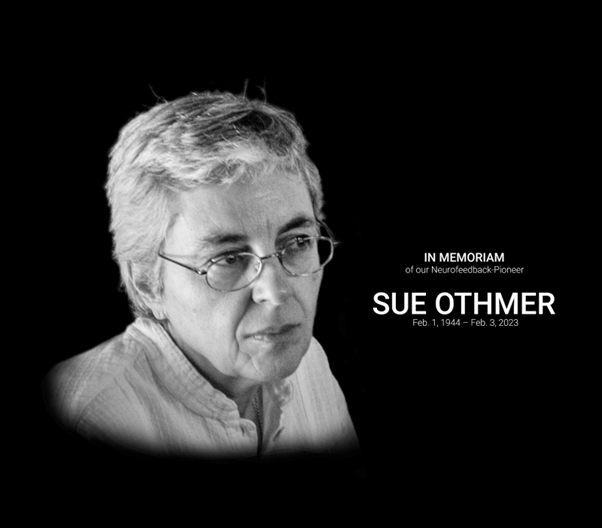
In memory of Sue Othmer

08. February 2023
Sue Othmer

When neurofeedback was discovered more than forty years ago, the potential of this therapy could be imagined, but at the same time countless questions arose from the beginning: what exactly is happening in the brain? How can the effects be explained? And, above all, how can effective approaches be developed for practical use, and how can the effects be measured? Challenges that persist to this day.

Sue addressed these very questions with an uncompromising focus: for her, the patient's symptoms came first, as well as observing their changes through neurofeedback. Her tireless, accurate and systematic observations of the effects in hundreds of thousands of neurofeedback sessions, enabled continuous development always based on previously known procedures. In doing so, she set new and unrivaled standards. The essence of scientific work and the spirit of the definition of evidence-based medicine were central. Guided by the highest respect for the patient's suffering, she worked with captivating curiosity. The Othmer procedure will be the reference against which new procedures will be measured for a long time to come.

Sue's scientific training and love of nature are reflected in her manner and work. Like few others, she was able to present and teach the complexity of the brain and the principles of self-regulation on which the entire clinical model of the method is based in a simple, clear, concise and very understandable way. She was concerned that therapists truly understand the neurofeedback process in order to address the needs of each brain individually in therapy.

Thus, Sue has also been passionate about sharing her knowledge and training to thousands of therapists over the decades. Today, her teaching is the basis for a large network of training institutions in 19 countries and 15 languages. Sue was uncompromising on this point as well: procedures were only included in her teaching and given the go-ahead when they were so practical that they could be used in daily clinical practice.

Through all her work, she has enabled countless people with long suffering to lead a life worth living and self-determined. Every day, tens of thousands of patients around the globe benefit from the effective therapy she has made possible.
 
We have had the honor of working with this outstanding figure in research and development for more than 15 years. We think of Sue with the utmost respect and appreciation, who will forever be remembered as an exceptional clinician and inspirational teacher & mentor.

We mourn her passing. The world is poorer by one incredible person.
 

Neurofeedback in “The Higher Practice Podcast for Optimal Mental Health”

27. October 2022
One of the pioneers of advanced Neurofeedback, Dr. Siegfried Othmer, has joined Keith Kurlander and Dr. Will Van Derveer, Co-Founders of the Integrative Psychiatry Institute and Integrative Psychiatry Centers, in their podcast “The Higher Practice Podcast for Optimal Mental Health”. Dr. Siegfried Othmer explains how Neurofeedback works and talks about how he personally started with Neurofeedback. Classical frequency band training, ILF Neurofeedback as well as ADHD and PTSD are discussed.
The whole episode can be heard on Apple Podcasts.


Open Day" on October 15, 2022 at BEE Medic GmbH in Forchheim as part of the Mental Health Action Week

03. October 2022

On 15 October 2022, BEE Medic GmbH will be holding an "Open Day". Under the motto of this year's Mental Health Action Week "Talking lifts your spirits - mentally healthy in our society", we will talk about mental health and show what role modern medical technology, such as neurofeedback, plays in this.

"Mental illness is still a taboo subject. A lot has already improved - especially in recent years - and people can talk more openly about mental illnesses, but hardly ever in the public sphere. That's why we're taking part in the nationwide Mental Health Action Week. We want to get people talking about what it actually means to be mentally healthy," says Johannes Spallek, managing director of BEE Medic GmbH, and continues: "Above all, we also want to show that the therapy of mental illnesses with technologies like neurofeedback can be easy and simply fun." 

Office

The open house will take place on October 15, 2022 from 10 am - 4 pm at Sattlertorstraße 48a in 91301 Forchheim.

On site, the team of BEE Medic as well as the Dipl.Psych. Stephan Kolbe and Erhard Beer, occupational therapist from Nuremberg, are available for questions.

For professionals with a medical and therapeutic background, there is also the possibility of a live demonstration.

Subscribe to Current News