Alpha-Theta Training
Course description
2-Part Course via Zoom (video conference)
After successfully completing the ILF Introductory Course and working with the technique in clinical practice for a while, you are now ready to learn more about the next steps in the protocol development. In this training course you will learn about the history of Alpha-Theta training and how to use this modality to enhance clinical outcomes, by allowing deeper processing of traumatic memories and promoting deeper healing. The course includes discussions and hands-on experience with this modality.
Online
Period of time
18.11.2025 – 19.11.2025
Local time: America/Los_Angeles
Your selected time zone
Price
400More Information
Cancelation/Refund Policy
Our group consult calls, workshops and many of our classes sell out. For this reason, we request that you cancel at least 3 days or more before your scheduled workshop/class. This will allow us to offer your spot to another Customer. You may email us at [email protected] to cancel.
Please note, we do not offer refunds. However, if you give us at least 24 hour notice of your need to cancel, we will credit your payment toward another workshop/class. However, if you do not cancel with at least 24 hour notice, you will lose any payments you have already made.
Language
- English
Lecturer
- Phone: +1818-584-1972
register*
Print course description
*By clicking on "register" you will be forwarded directly to the organizer of the course for booking. The organizer is also responsible for course organisation and invoicing.
Advanced ILF Neurofeedback Training
Course description
2-Part Course via Zoom (video conference)
This course is an in-depth learning experience designed to help refine the ILF Neurofeedback process to achieve the best training outcomes for clients. It includes discussions around frequency optimization and interpretation of arousal indicators in the clinical context, basic and specific training areas, alternate training protocols, lower frequency ranges and their indications, and how to make clinical decisions based on the client’s presentation and response to training. The course offers a better understanding of how specific software parameters are related to the Neurofeedback training process. Discussions on protocol optimization challenges for yourself or your most complex clients are also included.
Online
Period of time
08.10.2025 – 09.10.2025
Local time: America/Los_Angeles
Your selected time zone
Price
400More Information
Cancelation/Refund Policy
Our group consult calls, workshops and many of our classes sell out. For this reason, we request that you cancel at least 3 days or more before your scheduled workshop/class. This will allow us to offer your spot to another Customer. You may email us at [email protected] to cancel.
Please note, we do not offer refunds. However, if you give us at least 24 hour notice of your need to cancel, we will credit your payment toward another workshop/class. However, if you do not cancel with at least 24 hour notice, you will lose any payments you have already made.
Language
- English
Lecturer
- Phone: +1818-584-1972
register*
Print course description
*By clicking on "register" you will be forwarded directly to the organizer of the course for booking. The organizer is also responsible for course organisation and invoicing.
Customer Stories: Adriana King and Aurora Therapy & Neurofeedback
Meet Adriana King and Aurora Therapy & Neurofeedback in Ontario, Canada!
Adriana King, MACP, RP, BCN, is the founder and Practice Director of Aurora Therapy & Neurofeedback, located just outside Toronto in Aurora, Ontario. A Registered Psychotherapist and Board-Certified Neurofeedback Clinician, Adriana has extensive experience in trauma integration and brain-based healing. Her training spans ILF Neurofeedback, QEEG analysis, and a range of somatic and evidence-based modalities. Passionate about helping individuals heal from complex trauma, anxiety, mood disorders, and relational challenges, Adriana leads a dedicated team committed to restoring nervous system balance and long-term well-being.
Together, the team at Aurora Therapy & Neurofeedback has spent the past six years building a neurofeedback practice that meaningfully complements their psychotherapy work. Their journey began with training through the Trauma Research Foundation, which sparked a deeper exploration into neurofeedback’s potential to support healing and resilience.
They continued their path with formal training through Sadar Psychological, followed by advanced learning from highly respected experts including Diana Martinez (Boston Neurodynamics), Linda Walker and Dr. Manuel Halter (San Antonio), Mike Cohen (Center for Brain Training), and Roxana Saxu (Neurotopia). These experiences shaped their comprehensive and holistic approach to care.
“Since introducing Neurofeedback along with other evidence-based treatments, we have been more confident in working with clients who were labeled as resistant to treatment, or that had lost hope that healing was possible,” Adriana shared. “In particular, Neurofeedback helped clients with very sensitive nervous systems that kept them in a state of hyper-arousal response, as well as those with serious sleep difficulties and unable to concentrate and function in relationships and every day life.”
Aurora Therapy has been using BEE Medic systems since 2021. “Adding Neurofeedback has accelerated and complemented our efforts with other psychotherapy approaches. We found Cygnet, BEE lab & and CPT test to be user friendly and reliable systems.”
With neurofeedback now fully integrated into their daily practice, Adriana and the Aurora team continue to foster lasting transformation—one brain at a time.
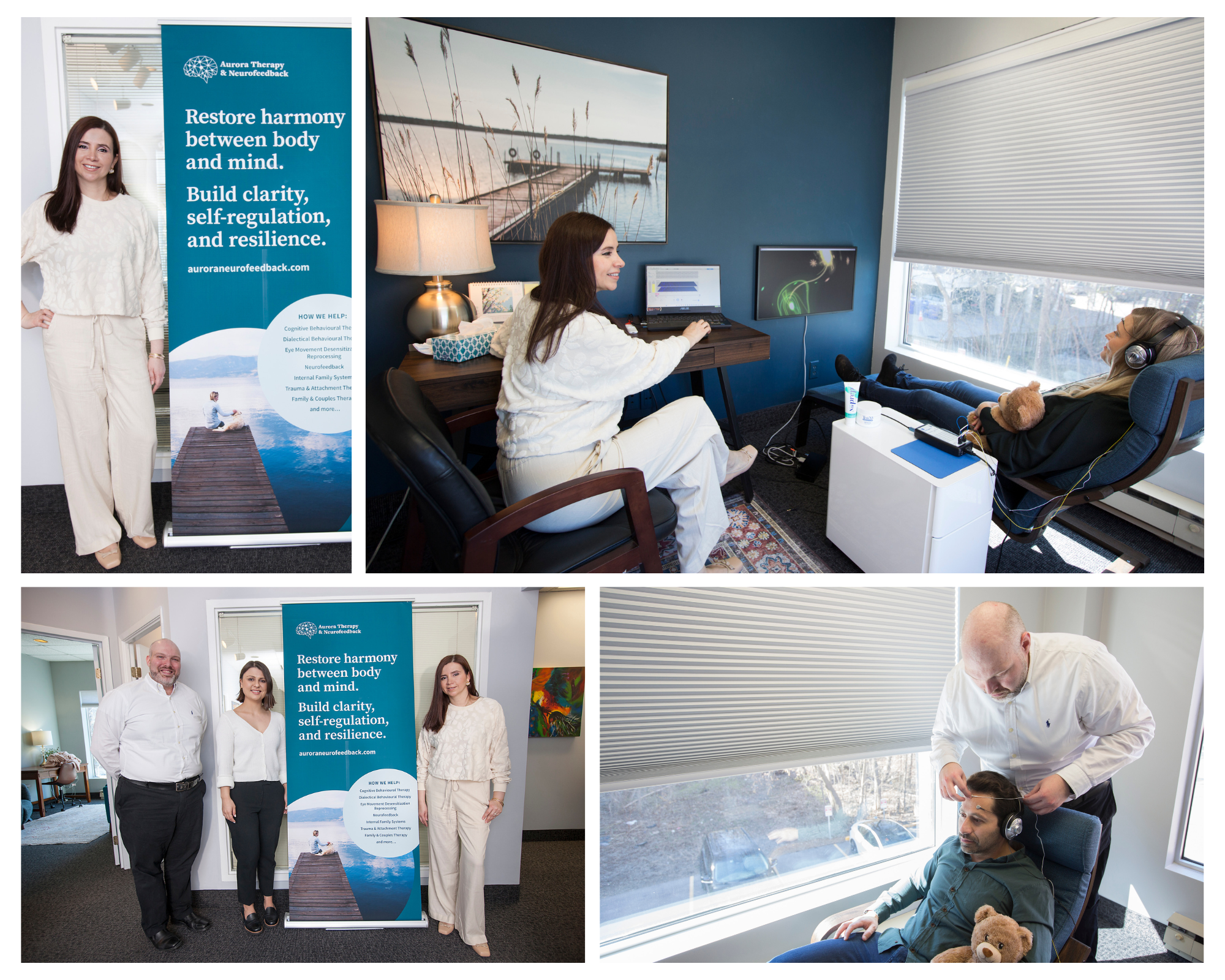
We are a team of Registered Psychotherapists in the Greater Toronto Area in Canada, providing a comprehensive therapeutic experience to our clients. Our approach is to holistically integrate the mind, body and brain within the psychotherapy process. We use evidence-based Psychotherapy treatments along with cutting edge Neurofeedback methods to foster a deeper healing experience and long-lasting benefits. Our team specializes in working with a multitude of symptoms and diagnoses (i.e. Complex Trauma and PTSD, Mood Disorders, Anxiety Disorders, Personality Disorders, as well as supporting students and adults with ADD and ADHD).
Get In Touch
Phone: 905-727-2487
Email: [email protected]
Website: auroraneurofeedback.com
Address: 203–15105 Yonge Street Aurora, ON, Canada
Neurofeedback Basic Course
Course description
Edukacija pruža sveobuhvatan uvod u tehničke detalje i kliničku primjenu neurofeedbacka. Uključuje predavanja, demonstracije, diskusiju i praktična iskustva. Radit ćete u skupinama po dvoje na našim neurofeedback sustavima koji su klasificirani i odobreni kao medicinski uređaj. Steći ćete znanja i iskustvo za početak rada s ovom inovativnom tehnikom za poboljšanje samoregulacije i osnaživanje moždanih funkcija. Metoda je razvijana od strane Othmerovih tijekom proteklih 25 godina. Tečaj je namijenjen polaznicima s terapijskim iskustvom koje žele naučiti ovu metodu poznatu po svojoj visokoj učinkovitosti. Nakon početne edukacije moći ćete odmah implementirati neurofeedback u vašu praksu.
Kako bismo Vam osigurali stručno praćenje u toku prve godine implementacije metode nakon pohađanja osnovnog tečaja imate pravo na sudjelovanje u 4 mjesečne grupne supervizije.
Essential teaching content
• Tehničke osnove različitih funkcija neurofeedback sustava i obrade EEG signala.
• Mehanizmi neurofiziološke samoregulacije i specifični oblici disregulacije koji vode do fizičkih, emocionalnih i bihevioralnih simptoma.
• Alati za procjenu koji omogućuju novi uvid u simptome Vaših pacijenata i usmjeravaju neurofeedback trening.
• Stjecanje iskustva s neurofeedback opremom pomoću koje vježbamo moždane mehanizme samoregulacije i poboljšavamo funkcije mozga.
• Stjecanje znanja i vještina koje će Vam omogućiti da uključite neurofeedback u svoju kliničku praksu.
• Osnaživanje pacijenata da bolje funkcioniraju i povećaju svoje sposobnosti što im omogućuje bolji učinak od drugih terapija.
After the course you can
• Opisati proces treninga EEG-a
• Koristiti neurofeedback opremu na osnovnoj razini
• Procijeniti primjenjivost neurofeedback treninga kod novih klijenata
• Opisati neurofeedback protokole za kliničku primjenu i vrhunsku izvedbu
• Procijeniti napredak klijenta i vrijeme završetka treninga
Course highlights
U početku Vašeg rada s neurofeedback metodom bit će vam potrebna podrška i savjeti stručnjaka. Ova temeljna edukacija jedinstvena je po tome što su polaznicima u cijeni osnovne edukacije osigurane i četiri grupne supervizije. Supervizije se održavaju jednom mjesečno u roku od godine dana nakon početnog tečaja, u predviđenim terminima.
Location
Zagreb - Vita Plena Neurofeedback Training CenterDubravica 41F
10090 Zagreb
Croatia
Period of time
09.11.2026 09:00 – 13.11.2026 16:00
Local time: Europe/Zagreb
Your selected time zone
Price
1.580,00 EUR-aIncluded in the price
- 5 dana teorije i vježbe
- puno praktikuma na opremi - tako da ćete odmah biti u mogućnosti implementirati neurofeedback u svoju praksu
- stručna podrška za vrijeme praktikuma
- ručak za svih pet dana
- osvježenja u vrijeme pauze - kava, čaj, sokovi, grickalice
- set stručnih materijala na hrvatskom jeziku
- završni ispit tipa višestrukog izbora (obvezno)
- potvrda o sudjelovanju
- sudjelovanje u 4 grupne mjesečne supervizije po završetku početne radionice
* Popust za dvije osobe iz iste tvrtke/institucije 8%
**Popust za ranu rezervaciju 8%
Popusti se ne mogu zbrajati.
Language
- Croatian
Lecturer
Organizer
Vita Plena jdoo
Palinovečka 45
Zagreb
Croatia
register*
Print course description
*By clicking on "register" you will be forwarded directly to the organizer of the course for booking. The organizer is also responsible for course organisation and invoicing.
The Role of Neurofeedback in Managing Menopausal Symptoms
Menopause is becoming more and more a focus of society. At a mean age of around 50, most women experience first menopause symptoms, which can vary according to the cultural, familiar and social background, but also according to the general health condition and well-being (Parazzini, 2006; Hu et al., 1999). According to the National Institute of Aging, menopause symptoms are reported to last around 2- 8 years with a large variety depending on genetics, but also external factors such as ethnicity, culture, lifestyle and environment (National Institute on Aging, 2024).
Symptoms are manifold and embrace hot flushes, night sweat, vaginal dryness, sleep disturbance, depression, anxiety, memory loss, fatigue, concentration disorder, mood changes, headache, joint pains and weight gain (Makara-Studzińśka et al., 2014). Around 50 million women annually go globally into menopause, which shows the high prevalence of this condition (Massart et al., 2001). A standard treatment to alleviate symptoms is hormone replacement therapy (Patel & Dhillo, 2021), but also the uptake of medication to ease symptoms like headaches, sleep disturbance or depression is commonly used. All of them can cause side effects, so alternative methods that help without adverse effects are needed.
One of the main causes of menopausal symptoms is the decrease in estrogen levels in the female body. The release of estrogen is controlled in the brain as well as the brain interacts also with it. It was shown that there are several brain regions that respond to estrogen such as the hypothalamus, the neocortex, but also hippocampus and brainstem, so a change in the estrogen levels also has an influence on the brain functions (Morrison et al., 2006), resulting in several symptoms with neurological origin.
Therefore the application of Neurofeedback, which can help to improve the brain's self-regulatory capacity, seems to be a promising approach. Several studies have shown that Neurofeedback can help with various of the above mentioned symptoms. In a publication with three case studies, it was shown that ILF Neurofeedback can help to alleviate symptoms of depression (Grin-Yatsenko et al., 2018). In addition, Virtual Reality ILF Neurofeedback has been used to address centralized pain accompanied by insomnia (Orakpo et al., 2022). A multicenter study involving 196 clients in an outpatient setting applied ILF Neurofeedback over approximately 30 sessions per participant, with continuous performance tests indicating improved attention (Schneider et al., 2021). Anxiety disorders, which encompass a wide range of symptoms, have also been explored in relation to Neurofeedback. A review on anxiety and depression highlighted the positive impact of Neurofeedback on these conditions (Hammond, 2005). Fatigue—commonly experienced by (post-)cancer patients and increasingly recognized as a component of Post-Covid syndrome—has also been a focus of recent research. A pilot study with 16 participants found that Neurofeedback may help alleviate fatigue-related symptoms.
These studies show that Neurofeedback can be an effective therapy for a variety of conditions. Since many of these indications—such as depression, anxiety, insomnia, and fatigue—are also common symptoms during menopause, Neurofeedback holds promise as a supportive treatment option for menopausal women as well. Especially ILF Neurofeedback seems to be a promising method as it is a symptom based approach.
Interested in more insights?
Dr. Dawn Harris, founder and CEO of Kedras Clinics, has been working successfully with Neurofeedback for years. In an article, she shares how neurofeedback can also be used in dealing with symptoms of menopause.

Sources:
Grin-Yatsenko, V., Othmer, S., Ponomarev, V., Evdokimov, S., Konoplev, Y., & Kropotov, J. (2018). Infra-Low Frequency Neurofeedback in Depression: Three case studies. NeuroRegulation, 5(1), 30–42. https://doi.org/10.15540/nr.5.1.30
Hammond, D. C. (2005). Neurofeedback treatment of depression and anxiety. Journal of Adult Development, 12(2–3), 131–137. https://doi.org/10.1007/s10804-005-7029-5
Hu, F. B., Grodstein, F., Hennekens, C. H., Colditz, G. A., Johnson, M., Manson, J. E., Rosner, B., & Stampfer, M. J. (1999). Age at natural menopause and risk of cardiovascular disease. Archives of Internal Medicine, 159(10), 1061. https://doi.org/10.1001/archinte.159.10.1061
Makara-Studzińśka, M. T., Kryś-Noszczyk, K. M., & Jakiel, G. (2014). Epidemiology of the symptoms of menopause – an intercontinental review. Menopausal Review, 3, 203–211. https://doi.org/10.5114/pm.2014.43827
Massart, F., Reginster, J. Y., & Brandi, M. L. (2001). Genetics of menopause-associated diseases. Maturitas, 40(2), 103–116. https://doi.org/10.1016/s0378-5122(01)00283-3
Morrison, J. H., Brinton, R. D., Schmidt, P. J., & Gore, A. C. (2006). Estrogen, menopause, and the aging brain: How basic neuroscience can inform hormone therapy in women. Journal of Neuroscience, 26(41), 10332–10348. https://doi.org/10.1523/jneurosci.3369-06.2006
National Institute on Aging (2024). What is Menopause. https://www.nia.nih.gov/health/menopause/what-menopause#:~:text=Symptoms%20related%20to%20menopause%20can,culture%2C%20lifestyle%2C%20and%20environment.
Orakpo, N., Yuan, C., Olukitibi, O., Burdette, J., & Arrington, K. (2022). Does virtual reality feedback at Infra-Low frequency improve centralized pain with comorbid insomnia while mitigating risks for sedative use disorder?: a case report. Frontiers in Human Neuroscience, 16. https://doi.org/10.3389/fnhum.2022.915376
Parazzini, F. (2006). Determinants of age at menopause in women attending menopause clinics in Italy. Maturitas, 56(3), 280–287. https://doi.org/10.1016/j.maturitas.2006.09.003
Patel, B., & Dhillo, W. S. (2021). Menopause review: Emerging treatments for menopausal symptoms. Best Practice & Research Clinical Obstetrics & Gynaecology, 81, 134–144. https://doi.org/10.1016/j.bpobgyn.2021.10.010
Schneider, H., Riederle, J., & Seuss, S. (2021). Therapeutic Effect of Infra-Low-Frequency Neurofeedback Training on Children and Adolescents with ADHD. In Artificial intelligence. https://doi.org/10.5772/intechopen.97938
Kelley Villegas
Profile
Kelley Villegas, is the founder of Focus NeuroRehab and brings over three decades of experience as an occupational therapist, with 20 years dedicated to infra-low neurofeedback. Since its founding in 2008, Focus NeuroRehab initially specialized in treating children with ADHD and Autism Spectrum Disorders and has since expanded to serve individuals of all ages. Kelley has successfully supported over 2,000 clients across a broad range of neurological conditions.
She is a seasoned speaker, having presented at EEG Info's Advanced Clinical Summits since 2012 and at the Integrative Medicine for Mental Health Conference in 2014. Kelley is also the co-author of Restoring the Brain: Neurofeedback as an Integrative Approach to Health (Chapter 8), published in 2015.
Customer Stories: Occupational Therapy Christian Rupp
Christian Rupp has been running his own occupational therapy practice in Postbauer-Heng, Bavaria, since 2005. Together with his team of eight, he offers a variety of modern and proven therapeutic approaches, including neurofeedback and biofeedback. The aim is to help children and adults cope better with the challenges of everyday life. Neurofeedback and biofeedback have been part of the practice's core treatment methods for six years. The focus is on therapeutic success for patients of all ages.
The practice team has found that children are often highly motivated by neurofeedback training and are able to improve their concentration and perseverance in particular. Adolescents can better regulate their cognitive and emotional challenges and adults experience noticeable improvements in emotional and physical self-regulation.
The team uses BEE Medic systems for treatment. ‘What I particularly appreciate about these devices is the high level of functionality, regular updates and fast support,' explains Christian Rupp. Neurofeedback is successfully used in the practice for a variety of conditions, including:
- Concentration and school problems
- Problems in social behaviour
- Deficits in self-perception
- Migraines and physical tension
- Restless legs syndrome and Parkinson's disease
- Chronic pain syndrome
- Anxiety and panic disorders
- PTSD
- Long Covid / Post VAC
- Sleep problems
"Neurofeedback enriches our daily therapy routine thanks to its ease of use and the ability to prepare sessions in a targeted way," says Christian Rupp. Neurofeedback can be used as a stand-alone method or integrated into regular, ongoing sessions.

About Christian Rupp Occupational Therapy
Christian Rupp has been a state-certified occupational therapist since 1997 and has had his own practice since 2005. His aim is to combine traditional, proven treatment methods with the findings of modern medicine.
In order to stay up to date, the entire team regularly undergoes further training.
In addition to Neurofeedback & Biofeedback, Christian Rupp is also trained in Alpha-Theta Neurofeedback & Synchrony Training. The practice also offers a variety of other specialised treatment concepts, including
- Dizziness diagnosis and treatment
- Qi Gong (individual and group)
- Paediatric therapy according to the Wunstdorf concept
- Hand therapy with afh certification
- Therapeutic climbing
- Craniosacral therapy
- Spinal therapy according to Dorn & Breuss massage
- Kinesiology tape incl. power spiral tape
- Foot reflexology
Here you will find further information and contact details:
[email protected]
phone: 09188 - 305 355
www.rupp-ergotherapie.de
Instagram: ergo.postbauer.heng
Brunnenweg 6
92353 Postbauer-Heng
Germany